Mercury 3: The 1,068 Tokens/Sec Diffusion Model vs GPT-6 Luna

Every fast AI model you have ever used plays the same waiting game. It writes one token, then the next, then the next, and a long answer takes a long time because the model physically cannot start word six until word five exists. On October 19, Inception Labs shipped a model that refuses to play. Mercury 3 is a diffusion language model: it drafts an entire answer as noise and refines the whole thing in parallel, the way an image generator resolves static into a picture. Inception says the result generates at 1,068 tokens per second on NVIDIA GPUs while matching or beating OpenAI's GPT-6 Luna and Anthropic's Claude Haiku 5.5 on quality. If even half of that holds up, the speed tier of AI just changed shape.
This guide covers what Mercury 3 actually is, how diffusion generation works, the full spec and pricing sheet, what Inception's own benchmark chart does and does not prove, how to try the model today, and the catches hiding under the headline number. One disclosure up front: every benchmark and speed figure in this story comes from Inception itself. Independent verification has not happened yet, and this article flags each claim accordingly.
What Is Mercury 3, in Plain Terms?
Mercury 3 is the third generation of Inception's Mercury line and the company's new flagship. The first Mercury, released in 2025, was a proof of concept: a commercial language model built on diffusion, the technique that powers image generators like Midjourney, instead of the autoregressive method behind ChatGPT, Claude and Gemini. It was fast and cheap, and it was treated by most of the industry as an interesting sidekick for simple, high-volume tasks.
Mercury 3 is Inception's argument that the sidekick era is over. The company says this model is more than 40 times larger than Mercury 1 in total parameters, that its aggregate benchmark intelligence roughly tripled across that growth, and that throughput stayed above 1,000 tokens per second the whole way. That last point is the actual news. Speed was never diffusion's problem. The open question, asked in every research discussion of the approach for two years, was whether quality would survive scale. Inception's launch post answers it directly: the scaling laws that drove autoregressive progress hold for diffusion too. That is a strong claim about a research direction, made by the company that benefits most if it is true, and independent researchers will now spend months trying to break it. For background on how the current speed tier got here, our guide to GPT-6 Luna and the GPT-4o retirement covers the models Mercury 3 is aiming at.
How Diffusion Writing Actually Works
The difference is mechanical, and it explains both the speed and the quirks.
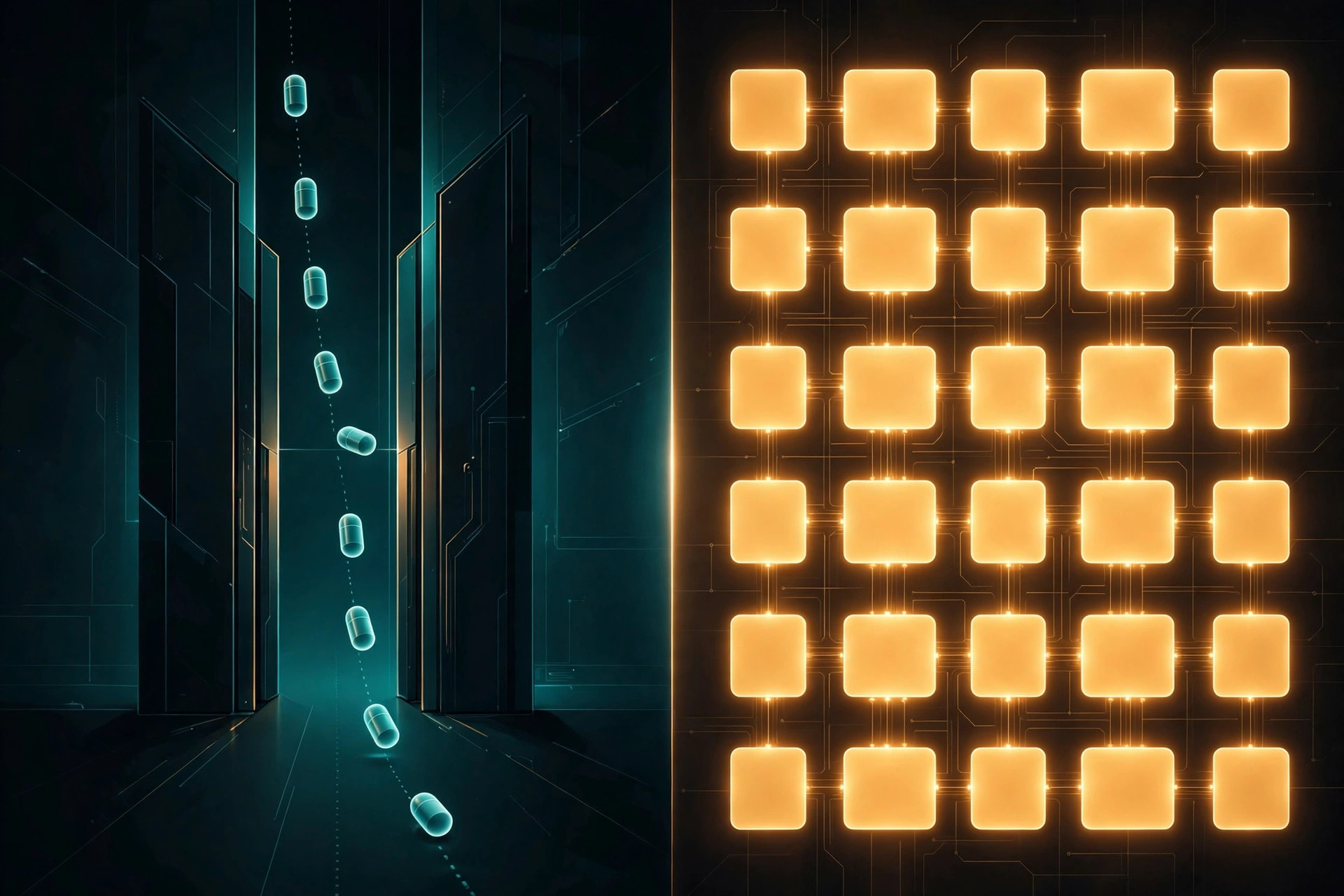
An autoregressive model, which is every mainstream chatbot, writes like a typewriter with no backspace key. It predicts token one, commits to it, predicts token two conditioned on token one, and so on. A 2,000-token answer needs 2,000 sequential steps, and no hardware on earth can parallelize a chain where every link depends on the finished shape of the previous one. Once a token is emitted, it is baked in, even if the model "realizes" three sentences later that it was the wrong word.
A diffusion model writes like a sculptor. It starts with a full-length draft made of noise and masked placeholders, then refines every position at once across a small number of passes, coarse to fine, exactly the way a diffusion image model turns static into a photograph. Position 500 can be revised on a later pass because of what position 5 turned into. Because the refinement steps run in parallel across the whole sequence, a GPU's actual strength, wide simultaneous math, does the work instead of its weakness, long serial dependency chains. That is where a number like 1,068 tokens per second comes from, and why Inception claims 4 to 8 times the throughput of speed-tuned autoregressive rivals on the same class of hardware.
The trade-offs are real and worth knowing before you build on it. A diffusion model plans in blocks, which makes very long, tightly structured outputs a different engineering problem than a left-to-right stream. Its editing behavior differs too: text can shift during refinement, which is a feature for drafting and a complication for applications that assume a stable prefix. And because almost every tool, framework and debugging habit in the ecosystem was built around token-by-token streaming, diffusion backends are still the path less traveled. None of that stopped developers from adopting stranger architectures before, but it is the honest context behind the speed headline. For a second opinion on the architecture and what it changes for inference code, this developer breakdown of Mercury 3 walks through the decoding loop in detail.
The Numbers: Specs and Pricing
Here is the full launch sheet, with every figure attributed to Inception's announcement as reported across launch coverage.
| Spec | Mercury 3 |
|---|---|
| Release date | October 19, 2026 |
| Architecture | Diffusion (parallel refinement, non-autoregressive) |
| Generation speed | 1,068 tokens/sec on NVIDIA GPUs (vendor-measured) |
| Context window | 1,000,000 tokens (up from 260K in Mercury 2.5) |
| List price | $0.20 / 1M input, $0.70 / 1M output |
| Launch price (50% off) | $0.10 / 1M input, $0.35 / 1M output |
| Cached input | 90% off list ($0.02 / 1M; $0.01 during launch) |
| Access | Inception API, OpenRouter, Baseten, Vercel |
| API style | OpenAI-compatible, with reasoning controls, tool calling, structured outputs |
| Weights | Closed, API only |
The pricing deserves a slow read. At launch rates, a million output tokens cost 35 cents. That is the territory of budget mini models, attached to a model claiming speed-tier frontier quality and a million-token window. Unite.ai's launch coverage confirms the structure: $0.20 and $0.70 list, halved at launch, cached input at $0.02 list and $0.01 on promotion. Two cautions. First, the 50 percent discount is explicitly a launch promotion; budget your application at list price and treat the discount as a bonus, because Inception has not published an end date and promotions in this market end quietly. Second, cached input at a cent per million is the number that matters for agent workloads with big repeated system prompts, and it is where Mercury 3's cost case gets genuinely hard to argue with. Compare that positioning with the subscription-and-token math in our GPT-6 intelligent UI guide and the three-way pricing fight in Muse Wonder vs GPT-6 vs Claude: the speed tier is suddenly crowded, and Mercury 3 is the cheapest seat in it.

Benchmarks vs GPT-6 Luna and Claude Haiku 5.5: What the Chart Shows
Inception's launch materials compare Mercury 3 directly against the two models it wants to displace: OpenAI's GPT-6 Luna and Anthropic's Claude Haiku 5.5, the current default choices for fast, high-volume work. The company's summary claim is that Mercury 3 is "on par or better" than both across a range of benchmarks. Its published chart shows Mercury 3 ahead on 8 of the 12 comparisons, including several that matter for real workloads:
| Benchmark (Inception's chart) | Mercury 3 | GPT-6 Luna | Claude Haiku 5.5 |
|---|---|---|---|
| BrowseComp+ | 55.18 | 50.50 | 45.78 |
| SWE-Bench Atlas | Leads (per chart) | Behind | Behind |
| GPQA Diamond | Leads (per chart) | Behind | Behind |
| IFBench | Leads (per chart) | Behind | Behind |
| DeepSearchQA | Leads (per chart) | Behind | Behind |
| DeepSWE v1 | Behind | — | Leads |
| MRCR v2 | Behind | — | Leads |
Read that table the way a careful buyer should. The wins cluster in agentic browsing, search and instruction-following, exactly the workloads where a fast model earns its keep, and the BrowseComp+ gap is not small. The losses are equally informative: Haiku 5.5 keeps the crown on DeepSWE v1 and on MRCR v2 long-context recall in Inception's own data, and Luna edges Mercury 3 on one long-context evaluation. A vendor chart that shows its own product losing four comparisons is more credible than one that shows a sweep, but it is still a vendor chart. The Neuron's review of the launch makes the same point: these are Inception's results, not an independent leaderboard verdict, and the exact numeric scores for several comparisons were described rather than published. Until third-party evaluators run Mercury 3 through standardized harnesses, treat the ranking as a well-supported claim, not a settled fact. If coding is your main workload, cross-check with our hands-on ranking of the best AI coding assistants before moving any production traffic.
How to Try Mercury 3 Today
Trying it is deliberately easy, because Inception made the API OpenAI-compatible. In practice that means most developers can test Mercury 3 by changing a base URL and a model name in code they already have:
- OpenRouter is the fastest route for a first test: Mercury 3 went live there on launch day, and you can route a few real prompts through it within minutes.
- Inception's own API is the direct route, with the launch discount and cached-input pricing applied, plus enterprise options for dedicated capacity, autoscaling and data-retention controls.
- Baseten and Vercel carry the model for teams already deploying through those platforms.
What you cannot do is download it. There are no open weights, no local deployment, and no fine-tuning story comparable to what the open ecosystem offers around models like the one in our DeepSeek V4.1-Flash guide. If your compliance setup requires self-hosting, Mercury 3 is simply not an option today, whatever the benchmarks say. A sensible evaluation path: take 50 real prompts from your own workload, run them through Mercury 3 and your current model side by side, and score latency and answer quality yourself. At these prices, that experiment costs less than a coffee, and it tells you more than any launch chart. Silicon Noon's launch analysis is a good companion read on why the company priced it this aggressively.
The Catch (There Are Four)
The benchmarks are self-reported. Speed, quality and the Luna/Haiku comparisons all originate with Inception. The 1,068 tokens-per-second figure was measured on the company's own setup, and real-world throughput on shared API infrastructure will vary with load, prompt shape and output length.
The launch price is temporary. Half-price tokens and 90-percent-off cached input are a promotion. Any cost model built at $0.10/$0.35 needs a plan for the day it becomes $0.20/$0.70, which is still cheap, but double.
The old models are being sunset. Mercury 2 and 2.5 are closed to new users, and existing Mercury customers keep access only until November 15. That is normal platform hygiene, but it is also a reminder that a young vendor's model lineup can change under you faster than the big labs' lineups do. The same lesson ran through the GPT-6.1 Astra cancellation: pin your integrations behind your own abstraction layer, whoever the vendor is.
Diffusion is still the minority architecture. Tooling, eval harnesses, community knowledge and debugging folklore overwhelmingly assume autoregressive models. Inception's scaling claim, if it replicates, changes that over time. Today, you are an early adopter, with an early adopter's support surface.
Who Should Care, and Who Can Wait
Care now if your product lives or dies on response latency: real-time agents, live coding assistance, voice pipelines, customer-facing chat at volume, anywhere a two-second pause is a lost user. A credible 4-to-8-times speed advantage at mini-model prices is exactly the kind of shift that rewrites unit economics, and the OpenAI-compatible API makes the test nearly free. Care, too, if you run high-volume workloads with large repeated context, where that cached-input price is close to unbeatable.
Wait if you need independently verified quality before touching production, if your stack depends on open weights or self-hosting, or if your workload is low-volume enough that speed was never your bottleneck. Mercury 3 will still be there when the third-party numbers land, and by then the launch discount question will have answered itself.
Frequently Asked Questions
What is a diffusion language model?
It is a language model that generates text by refinement instead of by sequence. Rather than predicting one token after another from left to right, it starts with a noisy, masked draft of the whole response and improves every part of it in parallel over several passes, similar to how diffusion image generators turn static into a picture. The parallelism is what makes models like Mercury 3 so fast.
How fast is Mercury 3, really?
Inception reports 1,068 tokens per second on NVIDIA GPUs, which it describes as 4 to 8 times faster than the speed-optimized models it compared against. That figure is vendor-measured and not yet independently verified, and your real throughput through a public API will depend on load, prompt size and output length. Even at a fraction of the claimed figure, it would be among the fastest hosted models available.
How much does Mercury 3 cost?
List pricing is $0.20 per million input tokens and $0.70 per million output tokens. A launch promotion halves both, to $0.10 input and $0.35 output, and cached input tokens are discounted 90 percent, to $0.02 per million at list and $0.01 during the promotion. The discounted rates are temporary, so budget at list price.
Is Mercury 3 better than GPT-6 Luna and Claude Haiku 5.5?
On Inception's own benchmark chart, Mercury 3 leads both models on 8 of 12 comparisons, including BrowseComp+, SWE-Bench Atlas, GPQA Diamond, IFBench and DeepSearchQA. It trails Haiku 5.5 on DeepSWE v1 and MRCR v2, and Luna on one long-context test. These are the vendor's numbers, not independent results, so the honest summary is: claimed parity or better, pending third-party verification.
Where can I access Mercury 3?
Through Inception's own API and via OpenRouter, Baseten and Vercel. The API is OpenAI-compatible, so existing code usually needs only a new base URL and model name. There are no open weights and no self-hosted option.
What happened to Mercury 2 and Mercury 2.5?
They are closed to new users. Existing Mercury customers keep access until November 15, 2026, after which the lineup centers on Mercury 3. If you build on Mercury 2.5 today, plan the migration now rather than in November.
The Bottom Line
Mercury 3 is the most serious challenge yet to a decade of autoregressive assumptions. A diffusion model that is 40 times larger than its proof-of-concept ancestor, claims speed-tier frontier quality, reads a million tokens of context, and rents for a dime per million input tokens is not a curiosity; it is a business proposition aimed directly at GPT-6 Luna and Claude Haiku 5.5. The claims are Inception's own, the discount is temporary, and the architecture is still the ecosystem's minority path. But the direction is unmistakable: writing in parallel works, it scales further than most people expected, and it is very, very fast. Run the 50-prompt test on your own workload this week, while the launch pricing lasts, and let your own numbers argue with the launch chart.
Reader reviews
Loading reviews…