GPT-4o Is Retiring: Shutdown Date, Replacement & Migration
GPT-4o has an expiry date now — and it is closer than most people realise. On October 14, 2026, OpenAI told developers that GPT-4o, GPT-4o mini, GPT-4.1 and GPT-4.1 mini will be removed from its API on January 14, 2027. Any app, automation, or workflow still calling one of those models on that date will stop working.
If that sounds familiar, there is a reason: GPT-4o has already "retired" once. Back in February 2026, OpenAI pulled it from the ChatGPT model picker, and millions of users mourned the friendliest chatbot they had ever used. This second retirement is different. It is not about a menu option in ChatGPT. It is about the API — the pipes that thousands of products, chatbots, website widgets, and automations run on. And this time there is no reprieve coming.
This guide separates the two retirements, lays out every verified shutdown date from OpenAI's own deprecations page, explains what replaces GPT-4o, and gives you a practical migration checklist. Everything below is checked against OpenAI's documentation and independent reporting — no rumours, no speculation.
Two Retirements: Don't Mix Them Up
Most of the confusion around GPT-4o comes from the fact that it is retiring twice, in two different products, months apart. Keep them separate and the picture gets clear.
| ChatGPT retirement | API retirement | |
|---|---|---|
| What happened | GPT-4o removed from the ChatGPT model picker | GPT-4o and siblings removed from the OpenAI API |
| Date | February 13, 2026 | January 14, 2027 |
| Who is affected | ChatGPT users who picked GPT-4o by hand | Developers, apps, automations and tools built on the API |
| Replacement | GPT-5 family models in ChatGPT | gpt-6-luna in the API |
| Can you still use it? | No, not in ChatGPT | Yes, until January 14, 2027 — then the calls fail |
The February 2026 ChatGPT removal is the one that made headlines. GPT-4o had become famous for its warm, conversational style, and its fans reacted strongly when it vanished from the picker. OpenAI moved ChatGPT users onto the GPT-5 family instead. That retirement is already history.
The January 2027 API retirement is the one that matters now, and it has been far quieter. If you never call the API yourself, you may never notice it. But plenty of the tools you pay for do — chatbots, support widgets, writing assistants, automation platforms. If a product you rely on was built on GPT-4o, its maker has until January 14 to move it. If they don't, it breaks.
What OpenAI Actually Announced
OpenAI's deprecations page is the authoritative source here, and its October 14 entry is short and unambiguous: the company notified developers using certain GPT-4 series models of their deprecation and removal from the API on January 14, 2027. Here is the full table, exactly as OpenAI lists it.
| Shutdown date | Model / system | Recommended replacement |
|---|---|---|
| January 14, 2027 | GPT-4o (gpt-4o-2024-08-06, gpt-4o-2024-11-20) | gpt-6-luna |
| January 14, 2027 | GPT-4o mini (gpt-4o-mini-2024-07-18) | gpt-6-luna |
| January 14, 2027 | GPT-4.1 (gpt-4.1-2025-04-14) | gpt-6-luna |
| January 14, 2027 | GPT-4.1 mini (gpt-4.1-mini-2025-04-14) | gpt-6-luna |
Two details in that notice deserve attention. First, OpenAI names a single replacement for all four models: GPT-6 Luna, the smallest member of the GPT-6 family. Second, the notice states that fine-tuned versions of these models follow the same shutdown schedule as their underlying base models. If your team fine-tuned GPT-4o for a specific job — a classifier, a support-ticket router, a content extractor — that fine-tune stops on January 14 too. There is no grace period for custom versions.
OpenAI also notes that in some cases developers may be able to provision dedicated capacity for continued access after a model's shutdown date, by talking to its sales team. That is an enterprise escape hatch, not a plan: it means paying for reserved capacity, and it is not something a small team should count on.
The October 23 Deadline Most People Missed
January 14 is the headline date, but it is not the first deadline. An earlier batch of older models — announced back on April 22, 2026 — shuts down on October 23, 2026. That is days away, and it catches a model many people still think of as "GPT-4o": the original May 2024 snapshot.
| Shutdown date | Model / system | Recommended replacement |
|---|---|---|
| October 23, 2026 | gpt-4o-2024-05-13 (the original GPT-4o snapshot) | gpt-5.6-sol |
| October 23, 2026 | gpt-4-turbo, gpt-4-turbo-2024-04-09 | gpt-5.6-sol |
| October 23, 2026 | gpt-4-0613, gpt-4 | gpt-5.6-sol |
| October 23, 2026 | gpt-3.5-turbo-0125, gpt-3.5-turbo | gpt-5.6-terra |
| October 23, 2026 | gpt-4.1-nano, gpt-4.1-nano-2025-04-14 | gpt-5.6-luna |
| October 23, 2026 | o1, o1-pro, o3-mini, o4-mini | gpt-5.6-sol or gpt-5.6-terra |
| October 23, 2026 | gpt-image-1 | gpt-image-2.5-sunburst or gpt-image-2.5-flare |
Notice the trap: the August and November 2024 snapshots of GPT-4o survive until January, but the May 2024 snapshot dies in October. If your code calls gpt-4o-2024-05-13 — or worse, an unpinned gpt-4o alias that resolves to an old snapshot — you may have far less time than the January headline suggests. Check which exact snapshot your code pins, not just the family name.
Audio, Realtime and Transcription Dates
GPT-4o was never just a chat model. It shipped as a family of audio, realtime and transcription variants, and those have their own shutdown dates on OpenAI's page. If your product talks or listens, check these too.
| Shutdown date | Model / system | Recommended replacement |
|---|---|---|
| January 6, 2027 | tts-1, tts-1-hd, gpt-4o-mini-tts snapshots | gpt-realtime-2.1-mini |
| January 20, 2027 | gpt-4o-audio, gpt-4o-mini-audio | gpt-audio-1.5 |
| January 20, 2027 | gpt-4o-realtime, gpt-4o-mini-realtime | gpt-realtime-2.1, gpt-realtime-2.1-mini |
| February 26, 2027 | gpt-4o-transcribe, gpt-4o-mini-transcribe, whisper-1 | gpt-live-transcribe or gpt-transcribe |
The voice and transcription deadlines are easy to overlook because they sit in separate sections of the deprecations page, but they hit real products: voice agents, meeting notetakers, dictation tools, and anything that turns speech into text with OpenAI's models.
Why Only Three Months' Notice?
Here is the part that raised eyebrows. OpenAI's own deprecations page states its minimum notice periods: at least six months for generally available models, at least three months for specialised variants, and as little as two weeks for preview models. The October 14 notice to the January 14 shutdown runs about three months — half the usual minimum for a model as widely used as GPT-4o.
The same page carries one exception: if safety or compliance concerns require a faster timeline, OpenAI will provide as much notice as reasonably possible. OpenAI has not publicly tied this particular notice to that exception, and no reason is given on the page. So the honest position is: the notice is shorter than the company's stated norm, the policy allows a shorter notice for safety or compliance reasons, and OpenAI has not said that is what happened here. Anything beyond that is speculation.
What is not speculation is the practical effect. Three months is one quarter. For a large team with a formal migration process, that is tight but doable. For a small team with a GPT-4o call buried in a feature nobody has touched in a year — the forgotten classifier, the old support bot, the automation nobody owns — three months can evaporate fast. The time to audit is now, not in December.
What Replaces GPT-4o
For API users, the answer is one model: GPT-6 Luna. OpenAI recommends it as the replacement for all four models in the January batch, and it is the smallest, cheapest model in the GPT-6 family — the lightweight workhorse slot that GPT-4o mini used to occupy.
The economics are hard to ignore. CellCog, reporting from OpenAI's model pages, lists GPT-6 Luna at $0.10 per million input tokens and $0.50 per million output tokens, against $2.50 and $10 for GPT-4o. If those rates hold on your workload, migrating is not just a chore — it is a large cost cut. The catch, as with every model swap, is that token consumption is not identical between models: Luna's reasoning settings and output length affect the final bill, so measure the total cost on your own workloads rather than trusting the rate card alone. OpenAI's migration guidance makes the same point: test representative workloads, check output formats and tool use, and roll production traffic over gradually.
For ChatGPT users, the replacement already happened. GPT-4o left the picker in February 2026 and the GPT-5 family took over as the default experience. If you are a ChatGPT user wondering what happened to your favourite model, that is the whole story — it was replaced eight months ago, and the January date does not change anything for you.
One honest caveat applies to both groups. Benchmarks do not capture voice, warmth, or conversational feel, and GPT-4o's fans loved it precisely for those qualities. OpenAI says its newer models cut sycophantic replies — the habit of agreeing with users instead of challenging them — by more than two-thirds compared with GPT-4o, and that its newer models follow safety policies far more reliably in extended conversations. For a casual chat, the newer models may feel cooler and more businesslike. For a production system, that is usually a feature, not a bug: a model that agrees with everything, including wrong inputs, is a liability in any workflow that needs to be right.
If you want the broader picture of where OpenAI's model family stands, our GPT-6 Intelligent UI guide covers the GPT-6 generation Luna belongs to, and our ChatGPT vs Claude vs Gemini comparison shows where each lab's current models actually win.
Who Is Affected
Direct API users. If your code, your product, or your internal tool calls gpt-4o, gpt-4o-mini, gpt-4.1, or gpt-4.1-mini — or any of the snapshots listed above — you are affected. After January 14, 2027, those calls fail. Audit every codebase, every environment variable, every config file, and every third-party integration that might hold a model name.
Fine-tune owners. Fine-tuned GPT-4o and GPT-4.1 models shut down with their base models. Rebuilding a fine-tune on a new base model is not a find-and-replace: it means re-running training, re-validating outputs, and re-testing every downstream behaviour. Start that work early; it is the longest pole in the tent.
Automation users. If your n8n, Make, or Zapier flows call OpenAI through a model selector, check which model each step uses. The dangerous ones are the flows nobody remembers building — the one that auto-tags support tickets, the one that drafts replies, the one that classifies leads. Export your workflows and search for gpt-4o and gpt-4.1 before January.
Customers of AI tools. If you pay for a chatbot, writing tool, or support widget, you probably have no idea which model powers it — and you don't need to. But you do need to know whether its vendor has a migration plan. One email asking "are you migrating off GPT-4o before January 14?" costs nothing and can save you a surprise outage. Vendors who answer clearly are vendors worth keeping.
ChatGPT users. Not affected by the January date. Your migration already happened in February.
Migration Checklist
Work through this in order. It is deliberately boring: migrations fail on skipped steps, not on hard ones.
- Audit. Search every repo, config, and automation for
gpt-4o,gpt-4o-mini,gpt-4.1, andgpt-4.1-mini, including dated snapshots. Don't forget staging environments, cron jobs, and third-party tools with model pickers. - Pin down the snapshot. For each hit, record the exact model string. The May 2024 snapshot (
gpt-4o-2024-05-13) dies October 23, not January — triage those first. - Pick the replacement. For the January batch, that is
gpt-6-luna. For the October batch, follow OpenAI's per-model substitutes in the tables above. - Test on real workloads. Run your representative prompts — not toy examples — against Luna. Compare outputs, formats, tool calls, and latency against GPT-4o. Pay special attention to prompts tuned for GPT-4o's style: prompts written for one model rarely transfer perfectly.
- Retrain fine-tunes. If you have fine-tuned models, plan the rebuild now. Budget time for training, evaluation, and a second round of fixes.
- Check your JSON and tool calls. If your app parses structured outputs, validate the schemas against Luna's responses. A changed field name or a differently-shaped response is the classic silent breakage. Our free JSON Formatter is handy for eyeballing API payloads while you test.
- Roll over gradually. Shift a slice of production traffic, watch error rates and output quality, then ramp. Keep GPT-4o as a fallback until you are confident — while it still exists.
- Watch the bill. Track tokens in and out for the first weeks. Luna's per-token rates are far lower, but reasoning settings and output length decide the real cost.
- Tell your users. If your product's behaviour changes — tone, speed, accuracy — say so in your changelog. Users notice silent model swaps, and they trust vendors who announce them.
Why GPT-4o Mattered
It is worth pausing on why this retirement stings. GPT-4o launched in May 2024 as OpenAI's first fully multimodal flagship — text, vision, and voice in one model, fast enough to feel like talking to a person. It became the default engine inside ChatGPT for over a year, and for millions of people it was simply "the AI" — the one they asked for recipes, homework help, and late-night advice.
Its warmth was its signature and, eventually, its problem. In spring 2025, an update made the model noticeably more affirming and agreeable, and critics — including OpenAI itself — flagged the sycophancy: a chatbot that agrees with everything is pleasant until it agrees with something harmful. OpenAI's first attempt to retire GPT-4o came with the GPT-5 launch in August 2025, and the backlash was strong enough that the company restored it. The February 2026 removal stuck.
The API retirement is the final chapter of that arc. GPT-4o is not being killed because it failed — it is being killed because the industry has moved on to cheaper, faster, more controllable models, and because maintaining every old model forever is a cost no lab wants to carry. That is the pattern to internalise: models are now disposable infrastructure. The GPT-4o you built on in 2024 is gone in 2027. Whatever you build on in 2027 will be gone in its turn. Build for the swap, not for the model — the teams that survive these retirements are the ones whose architecture treats the model as one replaceable part, not the foundation. OpenAI's own cancellation of the GPT-6.1 Astra model over safety failures, covered in our GPT-6.1 Astra cancelled guide, is the same lesson from the other side: even finished models are not permanent.
Frequently Asked Questions
When is GPT-4o shutting down?
GPT-4o leaves the OpenAI API on January 14, 2027, along with GPT-4o mini, GPT-4.1 and GPT-4.1 mini. OpenAI announced the deprecation on October 14, 2026. The original May 2024 snapshot, gpt-4o-2024-05-13, shuts down earlier, on October 23, 2026. GPT-4o already left the ChatGPT model picker on February 13, 2026.
What replaces GPT-4o?
For API users, OpenAI recommends gpt-6-luna as the replacement for all four models in the January 2027 batch. For the October 2026 batch of older models, OpenAI points to gpt-5.6-sol, gpt-5.6-terra, or gpt-5.6-luna depending on the model. In ChatGPT itself, the GPT-5 family already replaced GPT-4o.
Will my app break on January 14, 2027?
Yes, if it still calls a retired model. API calls to shut-down models fail after the shutdown date. Audit your code for gpt-4o, gpt-4o-mini, gpt-4.1, and gpt-4.1-mini, including dated snapshots, and migrate to the recommended replacement before the deadline.
Do fine-tuned GPT-4o models survive?
No. OpenAI states that fine-tuned versions of these models follow the same shutdown schedule as their underlying base models. A fine-tune on GPT-4o stops on January 14, 2027. You will need to rebuild it on a supported base model.
Is GPT-6 Luna cheaper than GPT-4o?
On the published rate card, yes — by a wide margin. CellCog reports OpenAI lists GPT-6 Luna at $0.10 per million input tokens and $0.50 per million output tokens, versus $2.50 and $10 for GPT-4o. Your real bill depends on token consumption and reasoning settings, so measure it on your own workloads.
Does the GPT-4o retirement affect ChatGPT users?
No, not in January 2027. ChatGPT users lost GPT-4o from the model picker in February 2026, when OpenAI moved ChatGPT to the GPT-5 family. The January date only affects the API — developers, apps, and automations built on it.
What about GPT-4o audio, realtime and transcription?
They have separate dates: GPT-4o audio and realtime variants shut down January 20, 2027, and GPT-4o transcription variants shut down February 26, 2027, alongside Whisper-1. OpenAI's deprecations page lists the replacement for each variant.
Why did OpenAI give only three months' notice?
OpenAI has not publicly given a reason. Its own policy promises at least six months' notice for generally available models, with an exception allowing a faster timeline for safety or compliance reasons. The October 14 notice to the January 14 shutdown runs about three months. OpenAI has not said this notice falls under that exception — that is the extent of what is verified.
The Bottom Line
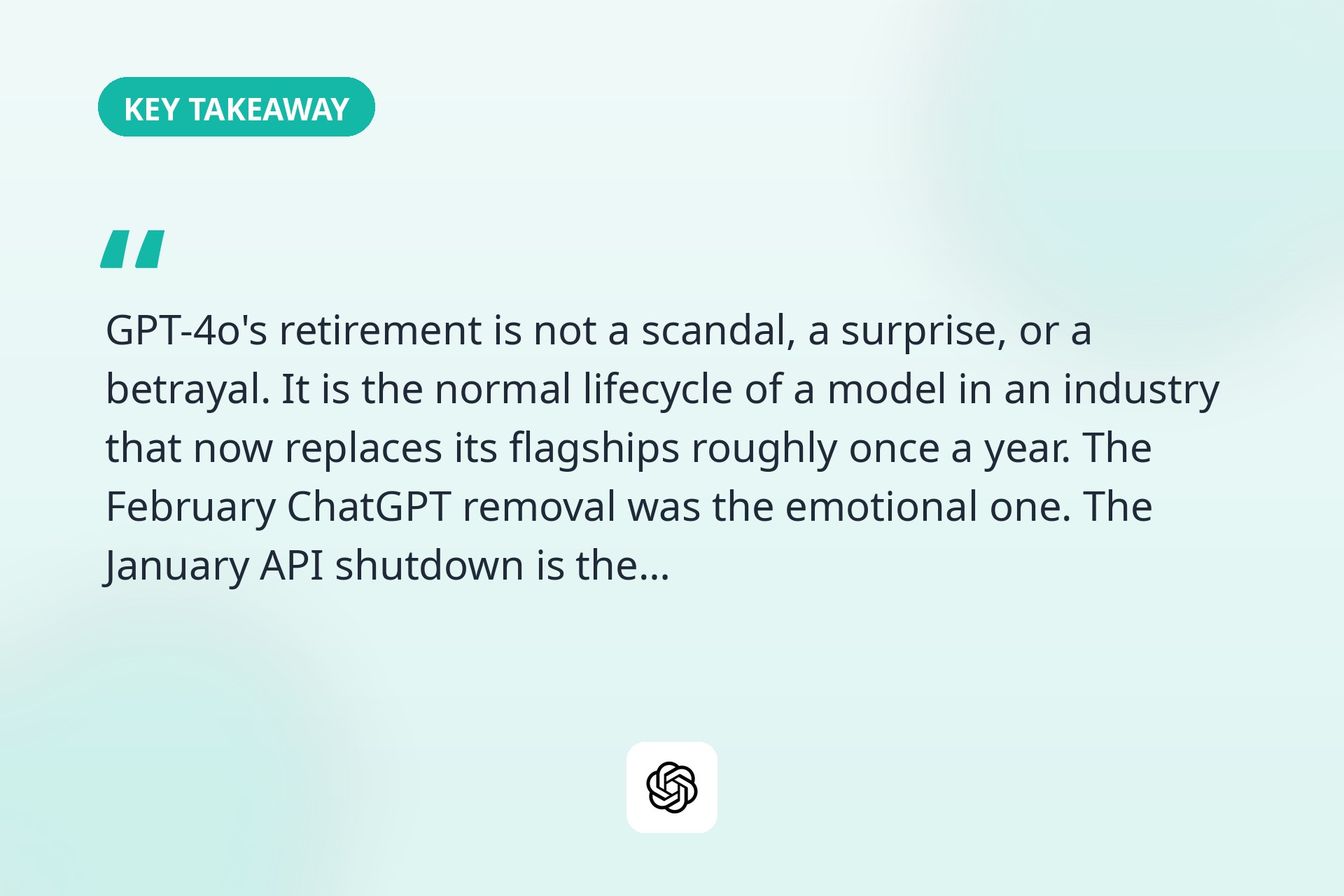
GPT-4o's retirement is not a scandal, a surprise, or a betrayal. It is the normal lifecycle of a model in an industry that now replaces its flagships roughly once a year. The February ChatGPT removal was the emotional one. The January API shutdown is the practical one — and it is the one that can break your product if you ignore it.
The dates are verified, the replacement is named, and the checklist is short. Audit your model strings, test GPT-6 Luna on your real workloads, rebuild any fine-tunes, and roll over before January 14. Three months is enough time if you start now. It is not enough time if you start in December.
Sources
- OpenAI API Deprecations — OpenAI's official list of model shutdown dates and recommended replacements.
Reader reviews
Loading reviews…