Google Gemini 4 Argon: Flagship Model, Price Catch, Verdict
On Tuesday, October 13, 2026, Google finally did the thing its rivals had been doing for months: it shipped a flagship. Gemini 4 Argon — the model Google DeepMind first teased to a handpicked group of cybersecurity defenders on September 30 — went globally available to developers, enterprises, and paying subscribers in a single day. Sundar Pichai announced it on X. Koray Kavukcuoglu, Google's chief AI architect, published the launch post. And the pricing came with a twist that deserves top billing: $2 per million input tokens and $10 per million output tokens, but only until November 30. After that, it doubles.
I spent launch day reading Google's announcement, the API docs, and the first wave of independent analysis, separating the real advances from the launch-day gloss. Here is the honest version: what Argon is, what the price catch means, how it actually scores against GPT-6, Claude, and Muse Wonder, and who should care.
What Actually Launched
One model, four doors in.
Developers get Argon through the paid tier of the Gemini API and AI Studio, effective immediately and globally. Model ID: gemini-4-argon. If you were holding off on routing changes until a public model ID existed, that wait is over.
Google AI Pro and Ultra subscribers get Argon in the Gemini app and in AI Mode in Search. The app also gained a new tasks mode — toggle it in the chat window and Gemini keeps working on a job after you walk away from your computer, with progress updates along the way.
Ultra subscribers additionally get Argon inside Google Antigravity, the agentic coding environment, which now runs directly inside the Gemini app for macOS — a chat can turn into a coding session without switching tools. (Google did not mention a Windows version.)
Enterprises get it through the Gemini platform, and Google is expanding its Fairwind partner program to hundreds of additional cybersecurity defenders — who can apply to use Argon without its cyber guardrails, on a rolling basis.
The backstory matters: Argon was announced September 30 and spent its first two weeks restricted to trusted cyber defenders. That staged rollout — defenders first, everyone else later — is Google signaling that it takes the dual-use question seriously, or at least wants to be seen taking it seriously. Either way, the model that went wide on October 13 is the same one defenders have been stress-testing for a fortnight.
The specs that matter: roughly 1 million tokens of shared context (1,048,576, input and output drawing from the same budget), adjustable reasoning effort (Low, Medium, High), tool calling, code execution, structured outputs, search grounding, URL context, file search, Google Maps grounding, and implicit prompt caching. Knowledge cutoff: March 2026. Rate details and the fine print on the continuation protocol live in Google's developer docs.
The Price Cut That Isn't
Let me put the catch front and center, because it is the single most important fact in this launch for anyone budgeting API spend.
Until November 30, 2026: $2.00 per million input tokens, $10.00 per million output tokens, cached input at 95% off.
From December 1, 2026: $4.00 per million input tokens, $20.00 per million output tokens. Double. Google's own footnote says so.
That means the "launch price" is a 48-day promotional window, and every cost comparison you do today has an expiry date. At $2/$10, Argon undercuts every frontier rival — it matches GPT-6 Sol's pricing and sits well below Claude Opus 5.5 and Muse Wonder at $4/$20. At $4/$20, it is priced exactly like the premium tier it is trying to join. The honest way to read this: Google is buying developer migration with seven weeks of half-price inference, betting that once your agents are built on Argon, you will not rip them out over the December price step.
There is a second, quieter pricing story. Google is offering 10,000 researchers the top Antigravity usage tier free for six months — a direct play for the academic and open-research community that has historically been Anthropic-leaning. Combined with the Fairwind expansion, Google is seeding Argon into the two communities whose benchmarks and papers shape the next news cycle. Smart distribution, and worth knowing when you read the glowing evaluations that will appear over the next month.
For the full competitive pricing picture, our ChatGPT vs Claude vs Gemini breakdown covers where each lab's models win — Argon now gives Google its strongest entry in that comparison in over a year.
The Benchmarks, Honestly
Here is where you need two scoreboards, because they tell different stories.
The Vals Index — which tests models on professional work across finance, coding, legal, and tax — puts Argon first at 68.90%, ahead of Claude Sonnet 5.5 at 67.04% and Claude Opus 5.5 at 66.97%. That is Google's headline, and it is real: on economically-grounded professional tasks, Argon leads the field as of mid-October.
The Artificial Analysis Intelligence Index is less flattering. There, Argon tied OpenAI's GPT-6 Astra and trailed two Anthropic models (as of the October 2 snapshot, before the wide launch). So on general intelligence evaluations, Argon is in the pack, not ahead of it. Both things can be true: Argon appears optimized for sustained professional and agentic work rather than general benchmark breadth.
On coding specifically, Google's September 30 unveiling had Argon at 77.9% on DeepSWE v1.1 — a long-horizon software engineering test — against 74.2% for Claude Opus 5.5 and roughly 74.1% for GPT-6 Astra. Coding is clearly the strong suit, which lines up with the Antigravity-first distribution strategy.
And then there are Google's internal claims: teams using Argon via Antigravity saw agentic code submissions rise more than 35% while code rollbacks fell by nearly a third. Flag these hard: Google disclosed no measurement period and no comparison baseline. They are directionally interesting and evidentially thin — treat them as marketing until independent teams publish their own numbers.
The most honest demo was not a benchmark at all. DeepMind showed Argon watching a single video of people playing cornhole, working out the physics itself, coding a simulation, and using that simulation to teach Apptronik's Apollo humanoid robot to sink seven consecutive shots. A YouTube channel stress-tested the million-token claim by asking for a field guide to 520 imaginary creatures — the task ran 3 hours and 22 minutes and stopped right at the 1M ceiling. These are stunts, but they are stunts about exactly the capability Argon is selling: staying coherent across very long, multi-step work.
Bottom line on benchmarks: Argon is a legitimate frontier model with a genuine lead on professional-task evaluations and coding, sitting mid-pack on general intelligence indexes. It is not the new undisputed king. Like Muse Wonder the day before it, "in the conversation" is the story — except Argon has the cheaper intro price and the stronger coding numbers.
The Million-Token Context, Explained
The 1,048,576-token context window is shared between input and output — both draw from the same million-token budget, which is a different design than windows that reserve output separately. In practice, the default synchronous output is capped at 65,536 tokens; for longer generations, Google points developers to a new "continuation protocol" in the docs that chains outputs within the shared budget.
Why does this matter? Because Argon's entire pitch is long-running work: agents that read a repository, plan, execute, test, and review without losing the thread. A shared million-token budget means an agent can hold a massive codebase in context and still have room to write. The cornhole demo and the 520-creature field guide are both advertisements for this exact property — coherence at extreme length.
The honest caveat: a million tokens of context is only as good as the model's ability to use the middle of it. Independent long-context evaluations (the "needle in a haystack" family of tests) have not yet been published for the GA release. Google's own numbers are promising; third-party verification is the next thing to watch.
What It Can and Can't Do
Inputs: text, images, video, audio, and PDFs. Multimodal in the full sense — the cornhole demo was video-to-physics-to-code.
Outputs: text only. No native image generation, no audio generation, and no Live API support on this model. If you need image or video out, Argon is not your model — look at the dedicated generators in our AI video and image guides instead.
Reasoning: three effort levels (Low, Medium, High), so you can trade cost against depth per request — useful given the December price step.
Agentic toolkit: function calling, code execution, structured outputs, search grounding, URL context, file search, and Google Maps grounding are all supported. Computer use is in preview. Implicit prompt caching is on, and cached input tokens are 95% off — which meaningfully softens the sticker price for repetitive agent workloads.
The pairing to notice: this model lands one day after Google's enterprise agent story took shape. If you read our Google Gemini agent guide, you know Google is pushing model-agnostic routing with coworker agents that carry their own identity. Argon is the flagship model that routing layer will reach for first — and the agent platform is the distribution channel that makes Argon's long-horizon strengths legible to enterprises. They are two halves of one strategy.
The Gemini App Gets Teeth
The consumer side of this launch deserves attention because it changes what the Gemini app is for.
The new tasks mode — one toggle in the chat window — lets Gemini keep working after you leave your computer, with progress updates as it goes. The app now connects to 40+ apps, including Instacart, OpenTable, Adobe, and Shopify, so a task can run as far as a grocery order or a booked table. Google says responses in the app now come "more directly with less hedging" and that the model repeats itself only when it needs to — small phrasing, but it signals a deliberate move away from the over-cautious assistant tone.
This is Google's answer to the question every lab is now asking: what does the chatbot become when the model can act? Tasks mode plus 40+ integrations is the consumer version of the agentic pitch — less powerful than the API, but the version a hundred million people will actually touch. If you are choosing between the big three assistants for daily use, our ChatGPT vs Claude vs Gemini comparison now has a genuinely new data point on Google's side.
Gemini 4 Argon vs the Competition
Here is the pricing and positioning table that matters, with the December step shown honestly:
| Gemini 4 Argon | Muse Wonder | GPT-6 Sol | Claude Opus 5.5 | |
|---|---|---|---|---|
| AA Intelligence Index | ~53 (tied Astra) | 52 | 53 (Astra) | 58 |
| Vals Index | 68.90 (#1) | n/a | n/a | 66.97 |
| Input / 1M tokens | $2.00 → $4.00 Dec 1 | $4.00 | $2.00 | $4.00 |
| Output / 1M tokens | $10.00 → $20.00 Dec 1 | $20.00 | $10.00 | $20.00 |
| Context window | 1,048,576 shared | ~1M | ~1M | 1M |
| API access | Yes (Gemini API, AI Studio) | Yes (Meta API, OpenRouter) | Yes | Yes |
| Weights | Closed | Closed | Closed | Closed |
| Standout | Long-horizon agents, coding, intro price | Active Memory | Cancelled successor; Sol ships | Top independent scores |
Two things jump out. First, at intro pricing Argon is the cheapest frontier API on the market — half the price of Opus 5.5 and Muse Wonder. Second, after December 1 it costs exactly what they cost. The table has a 48-day sell-by date, and so does any migration decision based on price.
The strategic read: Google is not trying to win on benchmarks alone — it is trying to win on distribution. The API, the app, AI Mode in Search, Antigravity, 100,000+ Googlers already using it monthly, 10,000 free researcher seats, the Fairwind defender pipeline. No other lab can put a frontier model in front of that many developers, consumers, and enterprises simultaneously. Meta has the social graph; Google has the everywhere-ness.
How to Access It
Developers: the paid tier of the Gemini API or AI Studio, model ID gemini-4-argon. Globally available as of October 13. If your agent stack already routes across models, add Argon to the rotation before the intro price expires — your own evals beat any table, and they are cheapest to run right now.
Gemini app users: Google AI Pro and Ultra subscribers get Argon in the app and in AI Mode in Search, plus the new tasks mode. Try a genuine multi-step task — plan something complex, hand it a messy project folder — and watch whether the progress updates and follow-through match the pitch.
Builders and tinkerers: Ultra subscribers get Antigravity with Argon inside, including on the macOS Gemini app. This is the highest-leverage way to test the coding claims hands-on.
Researchers: 10,000 free top-tier Antigravity seats for six months — if you qualify, this is the cheapest frontier evaluation environment available anywhere right now.
Enterprises comparing agent platforms should read this alongside our Google Gemini agent guide — the model and the agent platform are designed to sell together — and our best AI coding assistants roundup for where Argon-powered tooling fits in a real stack.
Honest Caveats
- The price doubles December 1. Every cost argument for Argon expires in 48 days. Budget against $4/$20, not $2/$10.
- The 35%/one-third claims are company-supplied. No methodology, no baseline, no independent replication yet.
- AA Intelligence Index: mid-pack. Tied with GPT-6 Astra, behind two Anthropic models. The Vals lead is real but narrow (68.90 vs 67.04).
- Text output only. No image generation, no audio generation, no Live API on this model.
- Long-context utilization unverified independently. The million-token budget is real; third-party "use the middle" tests are pending.
- Closed weights. Like every other frontier model this month, there is nothing to download or self-host.
- The researcher and Fairwind seeding shapes coverage. Expect a wave of positive evaluations from communities Google just gave free access — read them with the distribution strategy in mind.
Who Should Actually Switch
Try Argon now if: you are building long-running agents and want to test the coherence-at-length claims before the intro price expires; you want the cheapest frontier API available for the next 48 days; you are a researcher who can claim one of the 10,000 free Antigravity seats; or you live in Google's ecosystem (Workspace, Antigravity, AI Studio) where the distribution advantage compounds.
Wait if: you need the best general-intelligence scores (Opus 5.5 still leads independently); your workloads are short and price-insensitive to the intro window; or you need image/audio output from the same model.
Re-evaluate December 1 if: you migrated for the price — at $4/$20 Argon competes on capability alone, and the comparison with Opus 5.5, Muse Wonder, and GPT-6 Sol gets much closer.
Frequently Asked Questions
What is Gemini 4 Argon?
Gemini 4 Argon (gemini-4-argon) is Google's flagship frontier AI model, announced September 30, 2026 and made globally available October 13, 2026. It is designed for long-running, multi-step work — agentic coding, robotics, enterprise workflows, and scientific research — with a 1,048,576-token shared context window.
How much does Gemini 4 Argon cost?
Introductory API pricing is $2 per million input tokens and $10 per million output tokens (cached input 95% off) through November 30, 2026. From December 1, 2026, standard pricing of $4 per million input and $20 per million output applies.
Where can I use Gemini 4 Argon?
Developers: the paid Gemini API and AI Studio. Subscribers: Google AI Pro and Ultra in the Gemini app and AI Mode in Search; Ultra also in Google Antigravity. Enterprises: the Gemini platform. It was first available to vetted cybersecurity defenders in Google's Fairwind program starting September 30.
How does Gemini 4 Argon compare to GPT-6 and Claude?
On the Vals Index (professional tasks), Argon leads at 68.90% vs 67.04% for Claude Sonnet 5.5 and 66.97% for Opus 5.5. On the Artificial Analysis Intelligence Index it tied GPT-6 Astra (~53) and trailed two Anthropic models. On DeepSWE coding it scored 77.9% vs 74.2% for Opus 5.5.
What are the catches?
The intro price doubles on December 1, 2026. Output is text-only (no image or audio generation). Google's internal productivity claims are unverified. And it is closed weights, like every other frontier model this month.
What is tasks mode in the Gemini app?
A new toggle that lets Gemini keep working on a job after you leave your computer, with progress updates. The app now connects to 40+ apps including Instacart, OpenTable, Adobe, and Shopify.
The Bottom Line
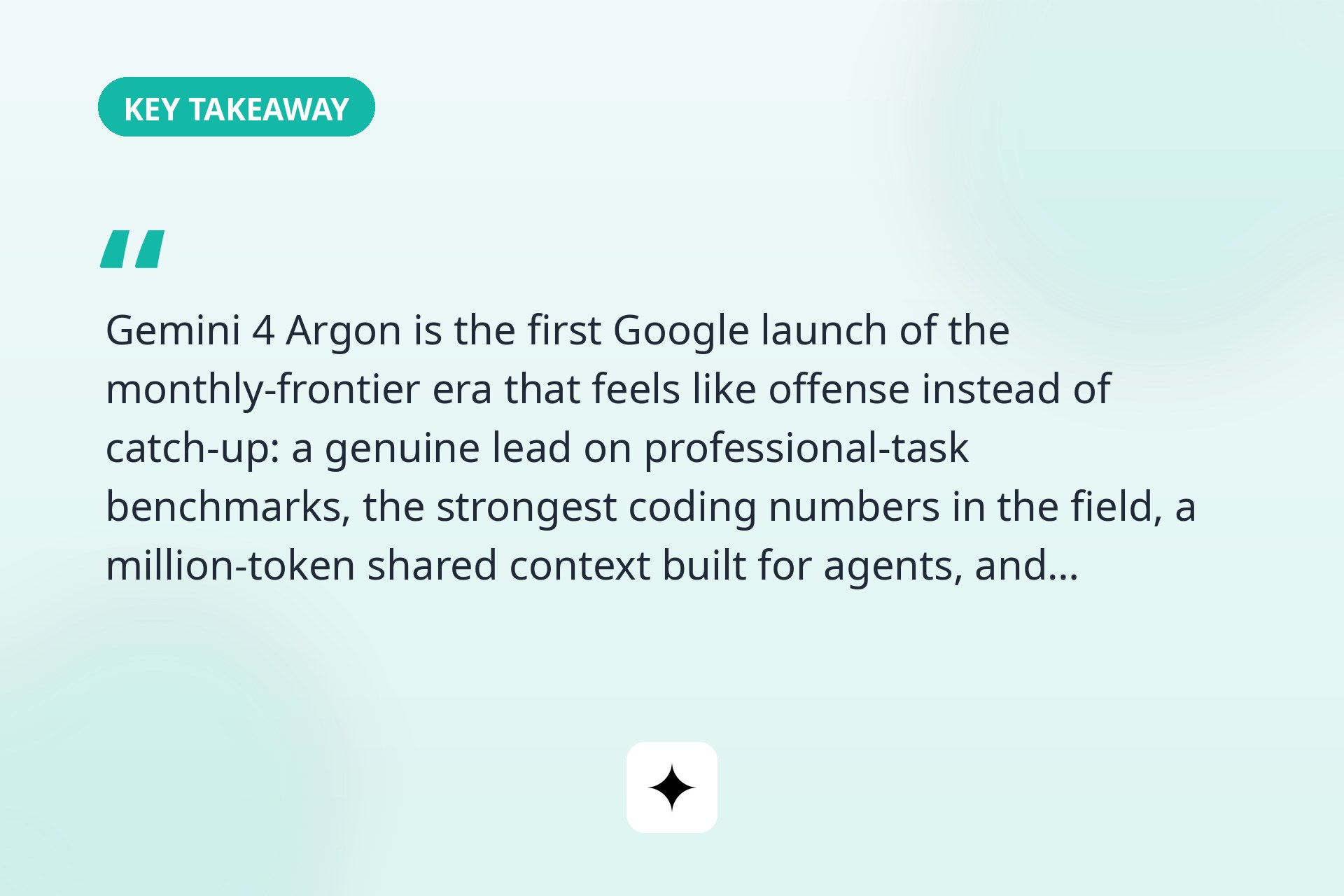
Gemini 4 Argon is the first Google launch of the monthly-frontier era that feels like offense instead of catch-up: a genuine lead on professional-task benchmarks, the strongest coding numbers in the field, a million-token shared context built for agents, and distribution no rival can match — API, app, Search, Antigravity, and a hundred thousand Googlers dogfooding it.
The catch is printed right on the price tag. Forty-eight days of half-price inference, then the same $4/$20 as everyone else. Google is renting your migration and hoping you stay for the ecosystem. That is a fair trade if you evaluate honestly: run your own agent workloads on Argon before December 1, measure what the long context and the coding gains are actually worth to you, and decide with your own numbers.
For everyone else, the practical take is simpler. The frontier now has five credible players, and the price of intelligence keeps falling in promotional windows while the sticker price holds. Argon makes Google a real choice again at the top of the market — the first time in over a year that has been true without qualification. The leaderboard got more interesting, and for the next 48 days, cheaper too.
Reader reviews
Loading reviews…