Genie 4 Is Here: DeepMind's AI Worlds Now Talk Back — and You Can Steer Them Live
How we write our guides: we start from the vendor’s own announcement or documentation, not from other “best of” lists. Launch dates and features are checked against that primary source; anything reported only by coverage is labelled as reported. Prices and allowances are given only when the vendor publishes them — otherwise we say “not published” rather than guessing. We do not invent test results, prices, or rankings. Our guides are drafted with AI assistance, then reviewed and edited before publication; the final call on what we recommend is a human one.
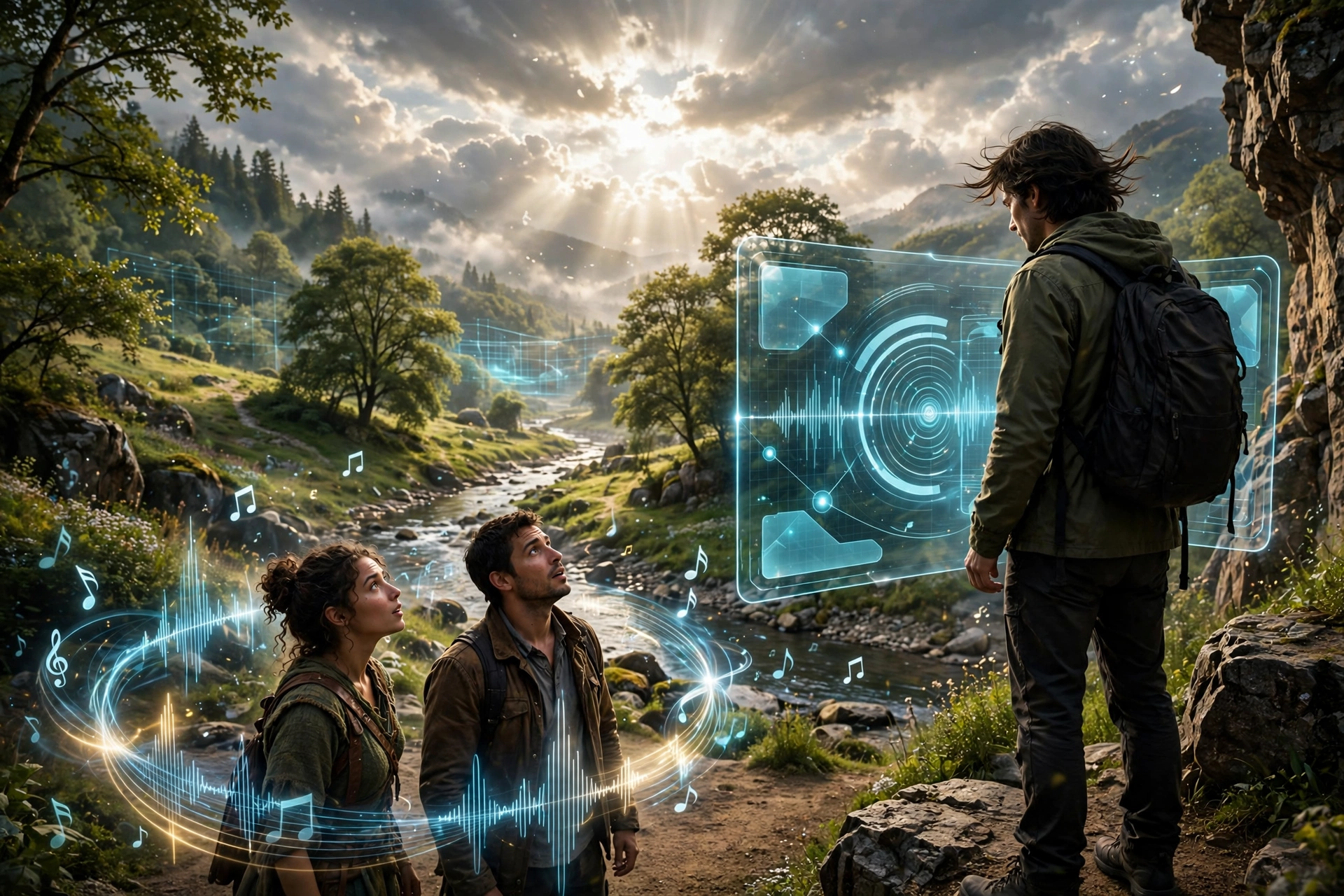
Every AI video you have ever watched had the same quiet flaw: it was a recording pretending to be a place. You could look at it, but you could not walk into it, change your mind halfway through, or ask the people in it a question. On October 27, 2026, Google DeepMind announced a model that treats that flaw as the whole problem. Genie 4 generates a world while you are inside it — frame by frame, in real time — and for the first time, the world it generates has a voice. Characters hold conversations; the sound is composed in the same pass that renders the picture. And when you type "make it night" or "add a street musician," the world does not restart. It obeys, mid-scene, while you keep walking.
What follows is the honest sorting: what Genie 4 is, what is new, who can use it (almost nobody, yet), and where DeepMind itself admits the seams show. One disclosure up front: Genie 4 is a research preview limited to trusted testers. I have not used it, and neither has anyone outside that circle. Everything here comes from DeepMind's own announcement and attributed coverage — vendor claims are labelled as vendor claims, and nothing here is a hands-on verdict.

What a World Model Actually Is (and Why It Is Not a Video Generator)
The fastest way to misunderstand Genie 4 is to file it next to the tools in our guide to the best AI video generators. A video generator renders a finished clip: prompt in, footage out, and if you want the camera two steps to the left, you generate again. A world model works the other way around — it predicts the next moment of a simulated environment continuously, in response to what the user does, closer to a game engine improvising itself than to a film being rendered.
That difference sounds academic until you list what it unlocks. A video of a robot picking up a cup is entertainment; a simulated kitchen a robot can practise in — ten thousand variations, with different lighting and clutter — is training infrastructure. A street you can re-light and re-stage live is a prototyping tool. DeepMind positions world models as a step toward AGI for exactly this reason: agents learning inside simulated worlds need them plentiful, variable, and responsive — and generating them is far cheaper than building them by hand.
Genie has been DeepMind's flagship line for this idea since Genie 1 in early 2024. Genie 3, previewed in August 2025, made the worlds photorealistic and explorable — but silent, and coherent for only about a minute. Genie 4's announcement, on the DeepMind blog, closes those two gaps and adds a third capability Genie 3 never had: a reasoning model riding inside the simulation, keeping events causally on track.
Advance One: You Can Steer the World While It Runs
Earlier world models, Genie 3 included, took their instructions up front: you described the world, entered it, and explored what you got. Genie 4 accepts direction continuously. DeepMind's examples are plain-language edits issued mid-simulation — change the weather, move the camera, introduce a new person or object — and the scene does not cut, reload, or restart; the change folds into the ongoing simulation, and the people and physics in motion respond to it.
This is the moment world models become directable, and directability is what separates a demo from a tool: a filmmaker does not want a beautiful street she cannot re-stage. One subtlety: your instruction is interpreted, not executed literally like code — a Gemini model adapts your prompt to the scene's current state, which is what keeps a mid-scene edit from shattering coherence.
Advance Two: Realism, Physics, and People Who Behave Like People
DeepMind leads with "unprecedented realism," which is launch language, but the specifics underneath are concrete: Genie 4 simulates physics including aerodynamics and collisions, and events play out with what the announcement describes as reliable causality — knock something, and the consequences propagate as your intuition expects, across complex, multi-step sequences.
The advance DeepMind singles out is people. Simulating humans is, in the announcement's words, "the most dramatic leap" in Genie 4: characters move naturally, respond organically to their surroundings and to you, and converse and react in real time. Earlier world models were weakest exactly here, their people drifting into mannequin behaviour and sliding gaits. Keep the claim in its frame, though: these are the maker's characterisations of its own research preview, illustrated with its own chosen footage. The limitations section below explains where DeepMind itself expects the illusion to crack.
Advance Three: Native Audio — the World Finds Its Voice
This is the advance that justifies the headline. Genie 4 is, per DeepMind, its first real-time world model to generate audio natively — and "natively" is the load-bearing word. The sound is not a separate audio model stitched onto finished visuals; it is generated simultaneously with the world, from the same simulation, so it is causally tied to what happens in the scene. A collision cracks when it lands; a cathedral carries a cathedral's reverberation. Music, ambient noise, and dialogue emerge from the same forward pass that renders the pixels.
Dialogue is the sharpest edge of this. Characters hold interactive conversations — they speak, respond to events, and react to you, in real time. A silent explorable world is a diorama; a world whose inhabitants talk back is a rehearsal space. DeepMind treats human speech as the frontier capability here — it is where failure is instantly obvious.
Advance Four: Gemini Inside the Loop
Genie 4 is not one model working alone. DeepMind has wired its Gemini family into the simulation itself, and the architecture is arguably the most consequential part of the announcement.
Two roles are described. Gemini Omni anchors the simulation — it grounds the world's appearance and behaviour in how the real world looks and acts. Gemini 3.8 Flash serves as a continuous guiding agent inside the loop: as Genie 4 renders, Flash observes the scene, decomposes goals into steps, verifies each step succeeded, and adapts the plan when something changes — including when the user intervenes mid-simulation. In Genie 3, an agent (SIMA 2) operated inside the world as a participant; in Genie 4, Gemini governs the generation itself. The reasoning layer has moved from actor to director.
That pattern — a fast generative model producing the world, a reasoning model supervising it — is the same division of labour now appearing across agent systems, and launch coverage such as TechTimes' breakdown of the architecture singles it out as the structural first that matters most; readers following our coverage of Google's Gemini agent push will recognise it. It is also what makes complex multi-step events feasible: a sequence spread over a minute needs something keeping the plot, and that something is Flash.
The Checkers Game: Argon, Genie, and a Robot Walk Into a Lab
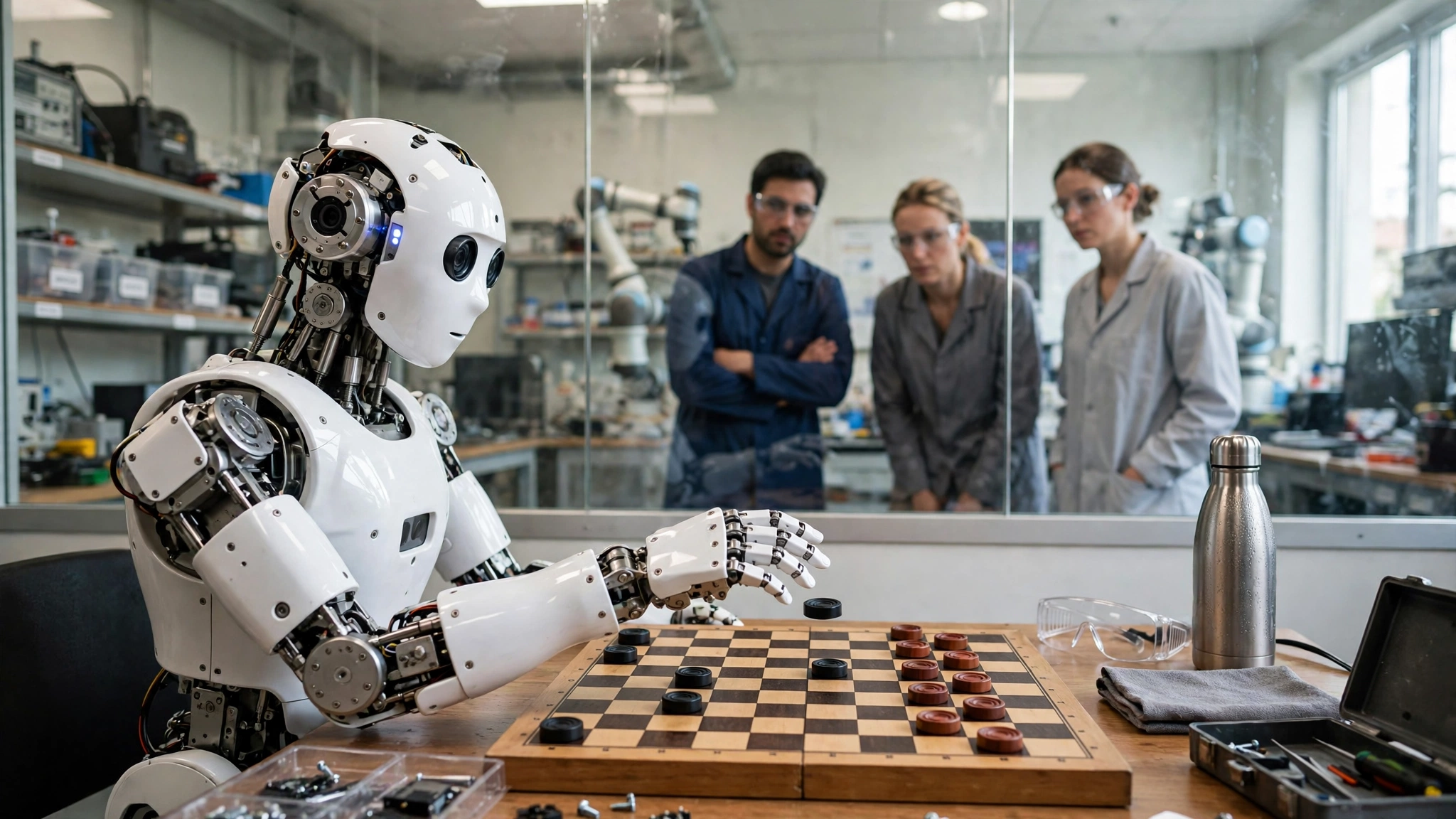
DeepMind's most striking demonstration combines three of its systems. In an experiment described in the announcement, Gemini 4 Argon — the flagship language model covered in our Gemini 4 Argon guide — breaks a task into steps; Genie 4 renders those steps as a simulated scene; and the result guides Apptronik's Apollo humanoid robot through a game of checkers. Language model plans, world model simulates, physical robot acts.
However staged any single demo is, the shape of it is the point: reasoning in language, rehearsal in simulation, action in reality — the pipeline researchers have described for years. It also explains why Google builds both model families at once: the agent that beat Minecraft in our Argon coverage and the world that can render a checkers board are one strategy.
Genie 3 vs Genie 4: What Actually Changed
| Feature | Genie 3 (Aug 2025) | Genie 4 (Oct 2026) |
|---|---|---|
| Audio | Silent — visuals only | Native audio: music, ambience, and interactive dialogue generated with the world |
| Talking characters | No | Yes — characters converse and react in real time |
| Mid-simulation steering | Instructions set at creation | Natural-language edits live: weather, camera, new people or objects |
| Coherent scene length | ~60 seconds | Up to ~2 minutes (per TechCrunch's briefing, via MarkTechPost) |
| Reasoning in the loop | Agent (SIMA 2) acting inside the world | Gemini 3.8 Flash guiding the generation itself; Gemini Omni anchoring appearance and behaviour |
| People simulation | Basic movement | "Most dramatic leap" per DeepMind — natural movement, organic responses, conversation |
| Physics | Simulated environments | Aerodynamics, collisions, multi-step causal events |
| Access at launch | Research preview; later Project Genie for AI Ultra subscribers (US, from Jan 2026) | Research preview for trusted testers; AI Ultra via Project Genie and API/AI Studio early-access partners next |
| Provenance | SynthID watermarking | SynthID watermarking on all video and audio |
Two honest footnotes. First, the two-minute figure comes from launch coverage of DeepMind's briefing, not a spec sheet — treat it as reported, not guaranteed. Second, DeepMind has published no resolution, frame-rate, or session-length specifications for Genie 4, so none appear here; Genie 3 ran at 720p and 24 frames per second, and anyone quoting you Genie 4 rendering specs is guessing.
Who Can Use Genie 4? Access, the Waitlist, and the Price That Isn't Published
Short answer: unless you are a trusted tester, you cannot use Genie 4 today — and this guide will not pretend otherwise. The rollout described in the announcement has three stages:
- Now: a research preview for trusted testers, who give feedback before any wider release.
- Next: Google AI Ultra subscribers, through Project Genie — the app where Genie 3 already runs for Ultra subscribers — plus early-access partners on the Gemini API and Google AI Studio for developers.
- Everyone else: a public waitlist for Project Genie, which DeepMind links from the announcement post.
On price, be precise, because the internet will not be: DeepMind has published no price for Genie 4 — no per-minute rate, no API tariff, no statement of what a session consumes from a subscription. Google AI Ultra is the announced consumer route in, but quoting Ultra's subscription price as "the price of Genie 4" would be inventing a fact. Until pricing appears, any number attached to Genie 4 is derived or guessed.
What the First Testers Are Doing With It
DeepMind's tester programme is small, but the use cases it names map where world models earn money first — because none of them is "make a fun clip."
Filmmakers are pre-visualising. Testers generate scenes and work them live — multiple "takes" of the same moment, adjusting camera position, lighting, and even dialogue on the fly, inside a world that talks back. A steerable, audible scene collapses the pre-visualization loop to typing speed.
Photojournalists are turning stills into situations. One tester workflow described in coverage expands a single 2D archival photograph into a navigable simulation — visualising how a flash flood moves through the street in the photo, or how a wildfire front behaves across photographed terrain.
Game developers are prototyping worlds before writing engine code. An explorable, populated, physics-obeying sketch of a level — generated, walked through, re-staged by typing — lets a small team test whether a space is fun to be in before committing engine weeks to it.
Enterprises are generating scenarios. Scenarios too expensive, dangerous, or impractical to stage — equipment failures, crowd behaviour, emergency conditions — can be simulated with people in them who react, which static training video cannot do.
Robotics teams are building training environments. The use case under the use cases: robots learn by practice, practice needs environments, and real-world environments are slow, breakable, and identical every time. Infinitely variable simulated worlds are how you give a robot ten thousand kitchens instead of one.
A Worked Example (Illustrative — Not a Real Session)
A fictional illustration for this guide: the person and session are invented, and no results or quality claims are made about real Genie 4 output.
Imagine an indie developer — call her Mara — prototyping a harbour-town level for a small adventure game. She opens with a text prompt: a fishing harbour at dawn, gulls, boats knocking against the pier, and walks the quay with keyboard controls to check sightlines. The light is wrong, so she types "golden hour, low sun over the water" and keeps walking as the scene re-lights around her. The fish market needs life: "add stallholders opening up, and a kid chasing a dog between the crates." She can hear the market waking up — crates, gulls, shouted greetings — because the audio arrives with the world, not after it. Then she stops at the two-minute coherence horizon, notes which sightlines worked, and goes back to her engine with a level she has already been inside — not finished content, but cheap, directable experience of a world before the world is built.
The Honest Limitations — in DeepMind's Own Framing
Launch coverage has been enthusiastic, so this section matters: DeepMind's announcement is unusually candid about the failure modes, and they define what Genie 4 currently is.
- Short sessions only. Genie 4 maintains coherence over short simulations. The reported figure is scenes of up to roughly two minutes; this is a sketching medium, not a persistent world.
- Drift is the core unsolved problem. Visual details and object permanence can shift or drift over time. DeepMind names the triggers specifically: longer runs, multiple complex prompt edits stacked on each other, and navigating around the scene. Turn around, and the world behind you may not be quite the world you left.
- Several capabilities are explicitly "active research areas": complex physics interactions, real-time audio accuracy, legible text rendering, spatial accuracy, and long-term consistency. Note that audio accuracy being a research area sits in honest tension with audio being the headline feature — the capability is new and first-generation, and DeepMind says so.
- Almost nobody can verify any of this independently yet. Public, sceptical, hands-on evaluation by people like the reviewers who stress-test the models in our ChatGPT vs Claude vs Gemini comparison has not happened, because access has not opened.
What Genie 4 Means for Games, Film, Robotics, and Creators
For games, the near-term impact is prototyping, not production. No studio is shipping a Genie 4 world as a game this year — two minutes of drifting coherence forbids it. But pre-production economics shift immediately: level concepts, mood tests, and NPC-behaviour sketches that cost weeks now cost prompts.
For film and video, the shift is pre-visualization with dialogue. Storyboarding is static and previz in a game engine is skilled labour; a steerable world where the actors talk back is a rehearsal medium.
For robotics and agents, Genie 4 is infrastructure. The Argon-plans, Genie-renders, Apollo-acts checkers pipeline is a template: any domain where agents must practise safely in varied environments — warehouses, hospitals, disaster response — is a customer for worlds on tap.
For creators, the honest advice is patience plus positioning. You cannot build a channel on a waitlist — but the trajectory that took image generation from research demo to daily tool in about two years is now visible for interactive worlds, and the creators who understood video models early were ready when access opened.

Frequently Asked Questions
What is Genie 4?
Genie 4 is Google DeepMind's newest world model, announced on October 27, 2026. It generates interactive, explorable simulated worlds in real time — you navigate with keyboard controls while the model renders each next moment in response to you — and it is DeepMind's first real-time world model to generate audio, including music, ambient sound, and character dialogue, natively alongside the visuals.
Can I use Genie 4 right now?
Almost certainly not yet. Genie 4 is a research preview limited to trusted testers. DeepMind says it will come next to Google AI Ultra subscribers through Project Genie and to early-access partners via the Gemini API and Google AI Studio, and a public waitlist for Project Genie is open. No general public or standard developer access has been announced.
How much does Genie 4 cost?
No price has been published. DeepMind has not announced a Genie 4 price, an API rate, or a usage allowance for any subscription tier. Google AI Ultra is the announced consumer access route, but Ultra's subscription price is not a Genie 4 price.
What is actually new compared with Genie 3?
Four things: native audio with talking, reacting characters; live natural-language steering mid-simulation (weather, camera, new people or objects); roughly double the coherent scene length — up to about two minutes versus Genie 3's ~60 seconds, per launch coverage; and a Gemini reasoning model (Gemini 3.8 Flash) guiding the generation itself, where Genie 3 placed an agent inside the world instead.
Is Genie 4 a video generator?
No — and the distinction matters. A video generator produces a fixed clip you watch. Genie 4 produces a live simulation you inhabit: it generates each moment in response to your movement and instructions, so two visits to the same prompt produce different experiences. It competes with game engines and simulators conceptually, not with clip generators.
What are Genie 4's biggest limitations?
DeepMind lists them itself: coherence only over short sessions; visual detail and object permanence that can drift over time, especially on longer runs, after repeated complex edits, or while navigating; and complex physics, real-time audio accuracy, legible text, spatial accuracy, and long-term consistency all remain active research areas.
Is Genie 4 output marked as AI-generated?
Yes. All Genie 4 video and audio carries SynthID watermarking, DeepMind's imperceptible provenance technology, so content produced by the model is identifiable as AI-generated. DeepMind also states that pre-launch safety evaluations were performed and guardrails are consistent with its other models.
The Verdict
Strip the launch gloss and Genie 4 still stands up, because its advances are architectural rather than cosmetic. Native audio is not a filter bolted onto silent footage; it is the world model treating sound as part of the world. Live steering is not a settings menu; it is directability, the property that turns a generator into an instrument. And Gemini in the loop — a reasoning model directing a generative one — is the clearest public signal yet of how DeepMind intends world models and language models to merge.
Hold it to the standard its own makers set, though. Two-minute worlds that drift when you turn around are a beginning, not a destination; access is a waitlist, not a product; and every capability claim here traces back to DeepMind's announcement and its chosen footage, because no independent public testing exists yet. The right reaction is neither hype nor dismissal — it is attention. The worlds have learned to talk back. What they say next is, increasingly, up to whoever is steering.
Reader reviews
Loading reviews…