Google Gemini Agent: What It Is, Who Gets It, and the Catch
By ToolPilot Pro · Updated 2026-10-12 · Productivity
#productivity#google gemini agent#gemini agent enterprise#gemini coworker agents#gemini agent vs microsoft copilot#gemini agent pricing#gemini agent release date#gemini agent private preview#universal ai agent for work
Google Gemini Agent: What It Is, Who Gets It, and the Catch
On October 8, 2026, Google Cloud CEO Thomas Kurian stood up at the company's Gemini at Work event and described "your new single, universal agent for work." The pitch: stop giving AI chatbots one-off prompts and start handing them objectives. The agent plans the work, spins up sub-agents, keeps going after you close the laptop, and shows its progress in a tasks inbox.
The headline detail, and the one everyone is talking about, is the coworker agent: a persistent AI worker that gets its own Workspace account. Its own email address. Its own calendar. Its own Drive storage. Its own seat in the company directory. You can add it to a Chat space, @mention it, tag it in a Doc comment, and its edits show up under its own name in version history.
I spent the days since the announcement reading Google's launch materials and the independent coverage from Reuters, CBS News, TechCrunch, 9to5Google, and the analyst firms, and separating what is actually shipping from what is keynote theater. Here is the honest version: what the Gemini agent does, the identity trick that makes it different, who can actually use it right now, and the catch nobody puts in the headline.
What Actually Launched on October 8
Let us get the logistics straight, because "Google launched an AI agent" undersells what was announced and oversells how available it is.
The Gemini agent is positioned as one universal entry point for work: chat, content, and code in a single interface. You assign an objective instead of step-by-step instructions. The agent plans the work, spawns temporary sub-agents that run in parallel or in sequence, and keeps working in the cloud after you close your laptop. Progress shows up in a tasks inbox that displays the agent's reasoning, the sub-tasks it delegated, the skills it loaded, and any code it wrote.
The listed capabilities cover the full enterprise workflow: answering questions, handling knowledge work, creating documents and media, writing and running code, and executing multi-day tasks. It works across web, mobile, desktop, and the command line, which matters because enterprise work does not live in one window.
It runs on Google's Gemini 3 model family, the same generation that already powers the Gemini app, Android Studio, and Google Workspace. Google has not specified a dedicated agent-only model variant.
What did not launch: a consumer version, a price, or a date when everyone gets it. The announcement was aimed squarely at CIOs, and the rollout reflects that.
The Coworker Agents: AI With Its Own Email Address
This is the part of the announcement that actually breaks new ground, so it deserves its own section.
A coworker agent is a persistent Gemini agent with a defined role. A manager describes the role, and the system creates an agent that holds its own Workspace account: an email address in the form @agents.company.com, a calendar, Drive storage, and a listing in the company directory. It acts under its own identity and sees only what colleagues share with it.
In practice, that means colleagues can add the agent to a Chat space, @mention it when they need something, invite it to meetings, or tag it in a Doc comment. When it edits a document, the edit appears under the agent's own name in version history. Every action is logged against the agent's cryptographically attested identity rather than a human user's, and IT governs the agents through standard identity management with per-agent audit trails.
Why does this matter? Because it solves the accountability problem that has haunted enterprise AI all year. When an agent acts under a shared service account or a human's credentials, nobody can cleanly answer "who did this and what were they allowed to touch." An agent with its own identity, its own permissions, and its own audit trail is something IT can actually govern. Microsoft's Agent 365 takes a similar stance, requiring every agent identity to have at least one human sponsor accountable for its lifecycle. Google is betting that identity-first agents are the price of admission for real enterprise deployment.
The open question is licensing. Normal Workspace user accounts are billed seats, and adding a user on a Flexible Plan raises the monthly bill. A company representative has said there are no plans for per-seat licensing of coworker agents in Workspace, but Google has not published the final metering model. Get the licensing answer in writing from your Google account team before the first team creates an agent account.
What It Connects To
An agent is only as useful as the systems it can reach, and this is where Google's announcement is strongest on paper.
The agent connects to Google Workspace, Microsoft 365 (including Teams), Slack, Jira, Confluence, Git, BigQuery, Databricks, Postgres, Snowflake, Salesforce, and ServiceNow, plus any Model Context Protocol (MCP) server. Permissions propagate through OAuth with action-level audit logging, which means the agent acts with the user's actual permissions rather than some elevated service credential.
Then there is the model routing, which is the most strategically interesting part of the whole launch. Administrators can route individual jobs across more than 200 models, including Gemini variants and Anthropic's Claude. Smart Routing picks the model per task. If Claude fits a particular job better, the agent hands it to Claude. That is a remarkable admission from Google: the universal agent is model-agnostic, and the company's own model does not always win.
Admins can also cap AI spend per project in the Cloud Billing Console. When a cap trips, the project's agent pauses, and an admin resumes it with one click. The practical advice from people who have run agent pilots: put pilot agents in separate projects, so one runaway job does not pause everything else.
Google also says consumer and enterprise Gemini will run on the same backend within three months, which would collapse the current split between the two product lines.
What a Workday With a Coworker Agent Looks Like
The announcement is abstract, so here is a concrete picture of how this is supposed to work once it reaches real teams.
Monday morning, a sales manager emails the team's coworker agent: "Prep me for the Thursday renewal call with Meridian. Pull the last quarter's usage from BigQuery, check the support tickets in Jira, and draft the renewal one-pager." The agent breaks that into sub-tasks, spins up temporary sub-agents to pull the data in parallel, and keeps working while the manager is in back-to-back meetings. The usage pull runs against BigQuery with the manager's own OAuth permissions, so it sees exactly what the manager is allowed to see, nothing more.
By afternoon, the tasks inbox shows the reasoning chain: which sub-agent pulled what, the SQL it wrote, the tickets it flagged, and the draft one-pager sitting in the agent's Drive folder, shared with the manager. The manager @mentions the agent in a Doc comment — "tighten the pricing section" — and the edit lands under the agent's name in version history. Every step is in the audit log under the agent's identity.
That is the vision, at least. The gap between this picture and private preview is exactly what the pilots are meant to close. But it explains why Google led with identity rather than model benchmarks: none of the above works if IT cannot answer who did what.
Who Actually Gets It Right Now
Here is the tier split, and it is stark: nobody outside private preview.
The agent launched in private preview for a select group of customers through the Gemini Enterprise app and Google Workspace, with wider rollout planned for select Workspace Business and Enterprise plans. Existing access to Gemini Enterprise does not necessarily mean every newly announced capability is immediately available to you.
No pricing has been published. No general-availability date has been announced. Industry-specific agents for financial services and legal are in preview. Analyst reports point to general availability around the end of October or early November 2026, starting in North America, but treat that as informed expectation, not a promise.
For context on where this sits in Google's lineup: Gemini Enterprise arrived as a chat interface at $30 per seat per month, and reporting indicates the agent's capabilities are included at no additional charge where Gemini Enterprise is available. That is reporting, not a price list. Until Google publishes one, budget conservatively.
The Early Evidence
Keynotes are cheap, so what matters is who is already running it. Google named several early customers, and the specifics are unusually concrete for a launch announcement.
Sportswear brand On tested the agent's dynamic model-selection capability. Shopify is blending frontier models across its merchant base. PayPal is routing 10 million multi-model requests every week through the system. Brazilian bank Bradesco cut a document review workflow from one hour to five minutes. Telecom operator Orange Spain has deployed more than 1,000 custom Gemini Enterprise agents.
Kurian's keynote also came with scale numbers aimed at CIOs: nearly 500 Google Cloud customers each processed more than one trillion tokens in the past year, nearly 80% of all Google Cloud customers now use its AI products, and nearly 90% of the Fortune 100 use Gemini Enterprise.
Keep the usual skepticism: these are vendor-selected stories, and none of them is an independent benchmark of end-to-end task completion. But they are more specific than the average launch-day customer slide, and the Bradesco and PayPal numbers in particular suggest real workloads, not demos.
The Catch
Every enterprise AI launch has a gap between the keynote and the contract. Here is Google's.
First, availability. Private preview means you cannot sign up for this today. If your company is not in the preview cohort, the Gemini agent is a roadmap item, not a tool.
Second, pricing. There is no price list, no plan breakdown, and no metering model for coworker agents. The "no per-seat licensing" comment is encouraging but it is a comment, not a contract. Enterprise buyers should get licensing in writing before building anything on top of this.
Third, proof. Google has announced a comprehensive architecture but has not published an independent benchmark of end-to-end task completion for the new agent, and has not demonstrated the cost savings of Smart Routing across representative production workflows. The audit trail story is strong on paper; buyers will judge it in pilots.
Fourth, positioning whiplash. Agentspace, Gemini Enterprise, and now the Gemini agent amount to three positions on the enterprise AI front door in less than two years. Google managed to acknowledge the churn, but customers have had to absorb a lot of rebranding. The promise that consumer and enterprise Gemini will converge on one backend within three months should help, if it holds.
Fifth, the competitive reality. Microsoft has shipped more specialized agents tied to individual Microsoft 365 apps and publishes its licensing rules plainly. OpenAI iterates rapidly on standalone agent features. Anthropic's Claude is, notably, a first-class model inside Google's own agent. The universal-agent pitch is the most coherent single-agent proposition a hyperscaler has made, but a good deal of what makes it interesting depends on rival platforms cooperating.
How It Compares to the Alternatives
The enterprise agent race now has three clear lanes.
Microsoft's Copilot agents are the incumbent play: persistent agents and coding context woven through Microsoft 365, with published licensing (Agent 365 at $15 per user per month standalone or inside the $99 E7 bundle) and a human-sponsor accountability model. Less ambitious as a single universal entry point, more legible as a purchase.
OpenAI's agent features iterate fast and live where many employees already work, but the company has been visibly churning its own lineup, including the recently withdrawn GPT-6.1 Astra model. Speed of iteration is both the selling point and the risk.
Google's Gemini agent is the coherence play: one agent, one API, one memory, one set of controls, following employees across Workspace, Microsoft 365, Slack, and the command line, with model-agnostic routing underneath. If your company already runs on Workspace and Gemini Enterprise, this is the most natural fit of the three. If it does not, the value proposition has to clear the switching-cost bar, and the missing price list makes that math impossible right now.
For individuals rather than IT departments, the honest advice is simpler: this is not your product yet. The consumer story is "within three months, one backend." Until then, the tools you can actually use today are the chatbots and the artifact features, like the ones covered in the recent GPT-6 and Claude guides. If you are still choosing between the big three assistants, our ChatGPT vs Claude vs Gemini comparison breaks down where each one actually wins.
What To Do If You Are Evaluating It
If you run IT or lead a team and the preview opens to you, a few practical notes drawn from the launch details and the pilot experience of early adopters:
Ask for the licensing terms in writing before anyone creates a coworker agent. The per-seat question is explicitly unresolved, and agent accounts that silently become billed seats are the kind of surprise that ends pilots.
Put pilot agents in separate Cloud projects. Spend caps apply per project, and one runaway job should not be able to pause every other agent in the company.
Start with a bounded, measurable workflow. Document review, like the Bradesco example, or a multi-system reporting task, gives you a before-and-after number. "Let the agent help with work" does not. For the personal-productivity side of the same problem, our best AI productivity tools roundup covers what individuals can deploy today without waiting on IT.
Treat the audit trail as the thing you are actually evaluating. The model routing and the sub-agents are impressive, but the enterprise buying decision turns on whether IT can see what the agent did, why, and what it touched. Run the pilot long enough to test governance, not just capability.
And keep an eye on the model-agnostic story. An agent that routes to Claude when Claude fits better is genuinely useful, but it also means your AI spend and your data flows now span two vendors' models. Make sure your security review covers that.
Frequently Asked Questions
What is the Google Gemini agent?
It is a universal AI agent for work that Google Cloud announced on October 8, 2026. It takes objectives instead of one-off prompts, plans multi-step work, coordinates temporary sub-agents, writes and runs code, creates documents and media, and works persistently in the cloud for hours or days. It is enterprise software, currently in private preview.
When will the Gemini agent be available to everyone?
There is no announced general-availability date. It is in private preview for select customers through the Gemini Enterprise app and Google Workspace, with wider rollout planned for select Workspace Business and Enterprise plans. Analyst reports point to late October or early November 2026, starting in North America, but Google has not confirmed a date.
How much does the Gemini agent cost?
Google has not published pricing. There is no price list, no plan breakdown, and no final metering model for coworker agents. A company representative said there are no plans for per-seat licensing of coworker agents in Workspace, and reporting indicates the capabilities are included at no additional charge where Gemini Enterprise (currently $30 per seat per month) is available. Get licensing terms in writing before building on it.
What are Gemini coworker agents?
Persistent agents with their own Workspace identity: an email address (in the form @agents.company.com), a calendar, Drive storage, and a company directory listing. A manager defines the role, the agent acts under its own identity, sees only what colleagues share with it, and every action is logged against its cryptographically attested identity. Colleagues interact with it by email, meeting invite, @mention in Chat, or tags in Doc comments.
Can the Gemini agent use Anthropic's Claude?
Yes. Administrators can route jobs across more than 200 models, including Gemini variants and Anthropic's Claude, with Smart Routing selecting the model per task. If Claude fits a particular job better, the agent hands it to Claude.
How is it different from Microsoft Copilot's agents?
Google positions the Gemini agent as one universal entry point spanning chat, content, and code with model-agnostic routing underneath, while Microsoft has shipped more specialized agents tied to individual Microsoft 365 apps with plainly published licensing. Google's identity-first coworker agents and cross-vendor model routing are the differentiators; Microsoft's legible pricing and installed base are its advantages.
The Bottom Line
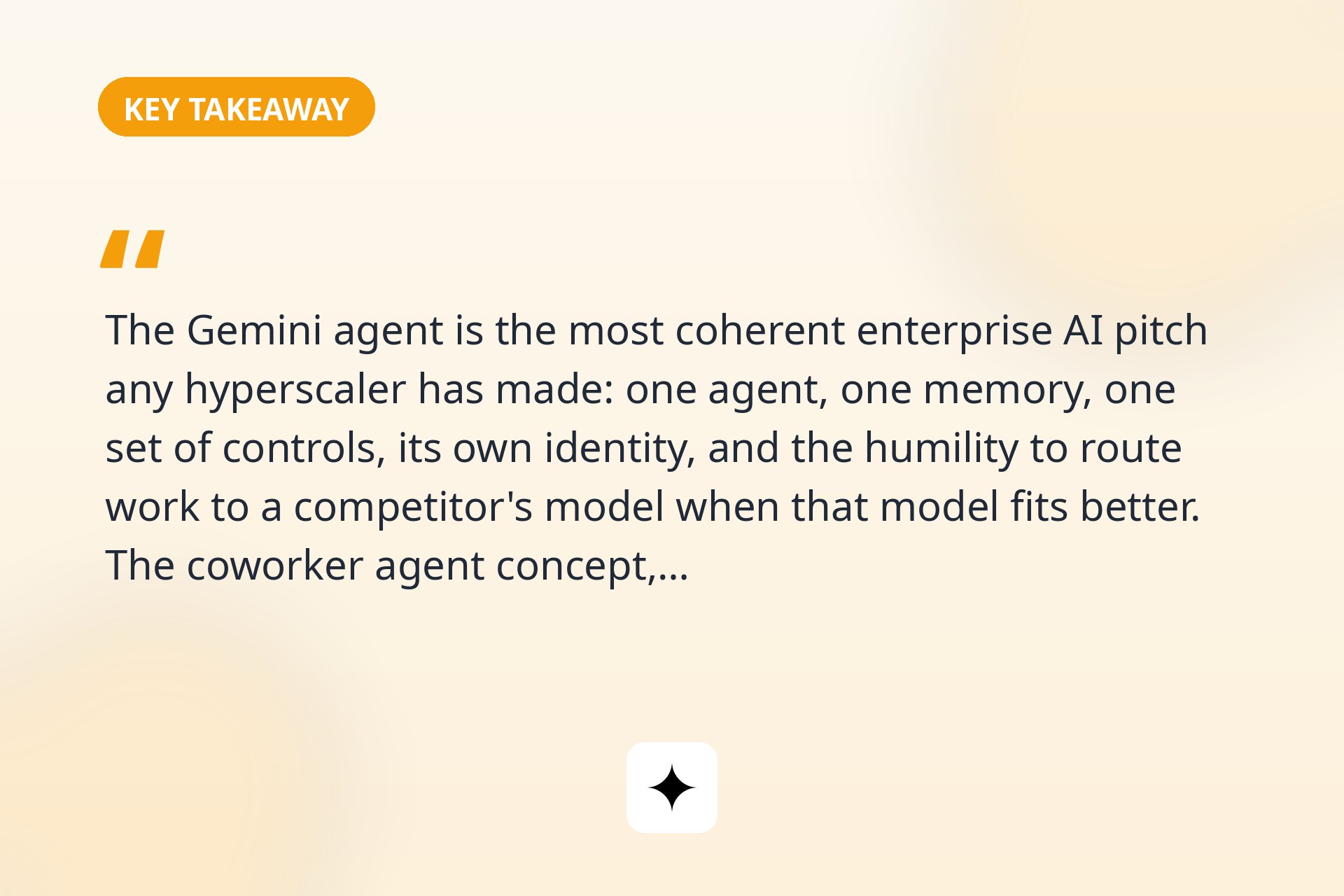
The Gemini agent is the most coherent enterprise AI pitch any hyperscaler has made: one agent, one memory, one set of controls, its own identity, and the humility to route work to a competitor's model when that model fits better. The coworker agent concept, an AI with its own email address and audit trail, is a genuine answer to the governance problem that has slowed enterprise AI adoption.
But it is a preview, not a product. No price, no GA date, no independent benchmarks, and a company that has repositioned its enterprise AI front door three times in two years. If you are in the preview, pilot it on a measurable workflow and evaluate the audit trail hardest. If you are not, put it on the roadmap and keep using the tools that exist today. The agent race is moving fast enough that by the time this reaches general availability, the comparison will look different again.