Trump Wants AI Renamed SI: What the Ban Claim Really Means
How we write our guides: we start from the vendor’s own announcement or documentation, not from other “best of” lists. Launch dates and features are checked against that primary source; anything reported only by coverage is labelled as reported. Prices and allowances are given only when the vendor publishes them — otherwise we say “not published” rather than guessing. We do not invent test results, prices, or rankings. Our guides are drafted with AI assistance, then reviewed and edited before publication; the final call on what we recommend is a human one.
Last updated: October 28, 2026.
On October 27, 2026, the President of the United States said he would ban a word. Not a product, not a company, not a technology — a word: "artificial intelligence", and its abbreviation "AI". In its place, he wants another phrase: "Super Intelligence", shortened to "SI". The announcement travelled fast because it sounds absolute, and absolute announcements are easy to share and hard to understand. This guide does the slower job: it reports exactly what was said on October 27, separates that statement from the executive order that already exists, and explains, in plain language, what changes for ordinary people, businesses, and writers — and what does not change at all.
The short version, for readers in a hurry, is this: the October 27 statement is a promise of a future ban in government documents, not a ban that took effect that day, and it does not make it illegal for you, your company, or anyone outside the federal executive branch to say "AI". The order that already exists, Executive Order 14434, signed on September 29, 2026, tells federal agencies to use "Super Intelligence" and "SI" in their own official, non-statutory documents. It does not rewrite any law, does not impose obligations on private parties, and carries no penalty for saying the old word. Everything else in this guide is the evidence for those sentences, the timeline behind them, and the practical guidance that follows from them.
What Trump Actually Said on October 27
Reuters reported the October 27 statement on the same day, and its account is the anchor for this section. According to Reuters, President Trump said in a post on Truth Social that he would ban the term "artificial intelligence" in documents and everything else, and questioned why The Wall Street Journal was not using his preferred term, "super intelligence". The post, as quoted by Reuters, reads:
"When will The Wall Street Journal start calling Artificial Intelligence (AI), a very bad and inaccurate name, SI (Super Intelligence), the name which virtually everyone else is using, or soon will be,"
And, in the same post:
"In short order, we will be officially BANNING the term, "AI/Artificial Intelligence," in all relevant documents and everything else due to its inaccuracy."
Three features of those sentences deserve attention, because each one is routinely lost in social-media summaries. First, the target is specific: "all relevant documents and everything else" is broad language, but the post is addressed to a newspaper's usage and framed as a government-documents question, not as a criminal law. Second, the timing is vague: "in short order" is a promise, not a date, and no document putting the ban into effect was published with the post. Third, the claim about universal usage — "virtually everyone else is using, or soon will be" — is a rhetorical claim, not a measured fact: the technology industry overwhelmingly still calls the technology "AI", and the evidence for that is visible in every product name, job title, and search query in use today.
The Wall Street Journal detail matters because it reveals the argument's logic. The President's complaint is that a major newspaper has not adopted the new term. That is a complaint about language norms, not about a statute. Newspapers choose their own style, and nothing in the September executive order directs newspapers to change theirs. The October 27 post, as reported, does not add such a direction either — it states an intention to ban the term in relevant documents, without specifying the legal instrument that would do it.
It is also worth recording what the post did not do. It did not name a penalty. It did not name an enforcement agency. It did not list the documents covered, beyond "all relevant documents". And it did not say that private citizens, companies, schools, or journalists would be punished for using "AI". Any summary that claims otherwise is adding words the post, as reported, does not contain.
The Timeline: How "SI" Got Here
The October 27 post did not come from nowhere. It is the third beat in a sequence that began more than a month earlier, and understanding the sequence is what turns a confusing headline into a comprehensible policy story.
September 22, 2026: the United Nations speech. President Trump told the UN General Assembly that US government documents would say "super intelligence" in place of "artificial intelligence", according to reporting on the rename. This was the public debut of the idea: a speech, not a legal instrument, but a clear signal of intent from the highest level.
September 29, 2026: Executive Order 14434. The President signed Executive Order 14434, titled "Inaugurating the Era of Super Intelligence", which formally directed federal agencies to use the new term. The order was later published at 91 Federal Register 63129 on October 2, 2026, according to legal analysis from Arnold & Porter. The same day, the President and leaders of six technology companies signed the White House Accord on Super Intelligence, a set of voluntary commitments on frontier-model controls and audits, according to reporting on the accord. The accord is voluntary: it is a pledge, not a regulation.
October 8, 2026: the "THE ENEMY" post. In a Truth Social post on October 8, the President wrote that the White House considers anyone who uses the term "Artificial Intelligence", as opposed to the new term "Super Intelligence", to be "THE ENEMY", according to BusinessToday's report of the post. The language is striking, and it is worth stating plainly what it is and is not: it is a social-media post expressing the administration's position. It named no consequences, created no rule, and did not change the legal position established by the September order.
October 9–10, 2026: companies start moving. On October 9, Salesforce chief executive Marc Benioff wrote on X that "AIForce is officially SIForce", renaming Salesforce's AI platform in a nod to the White House push, according to CXM's report. Around the same time, Elon Musk said SpaceXAI would become SpaceXSI, and Microsoft's Satya Nadella used "Super Intelligence" as two capitalised words in an X post, according to the same reporting. These are voluntary company decisions, not compliance with a legal requirement — the order does not direct private companies to rename products, and these companies chose to align themselves with the administration's language for their own reasons.
October 27, 2026: the ban promise. The Truth Social post reported by Reuters, quoted in full above, revives and escalates the campaign: from a preference, to an executive order for federal documents, to a promised ban. That escalation is the news. What has not escalated, at the time of writing, is the legal instrument behind it.
What Executive Order 14434 Actually Does
Executive Order 14434 is the only binding document in this story, so it deserves a precise reading. Based on Arnold & Porter's legal analysis and other coverage of the order, its operative content is as follows.
The order directs executive-branch departments and agencies to use the terms "Super Intelligence" and "SI" in place of "artificial intelligence" and "AI" in official correspondence, public communications, websites, reports, policy documents, and other non-statutory documents within the executive branch, to the maximum extent permitted by law. The phrase "to the maximum extent permitted by law" is doing important work: it means the direction yields wherever a statute requires the old term, and it does not override legislation.
The order defines its own key term narrowly. For its purposes, "Super Intelligence" means the technologies already covered by the statutory definition of artificial intelligence in US law, specifically 15 U.S.C. 9401(3), the definition in the National Artificial Intelligence Initiative Act of 2020. In plain language: the order takes the existing legal category, keeps its contents exactly as they are, and gives it a new label for federal documents. That is why the claim that the technology itself has changed is wrong, and why the claim that today's systems are technically "superintelligent" in the science-fiction sense is not established by the order. The order's own definition points back to the old category.
The order also starts a process with a deadline. It gives the President's science and technology adviser 60 days from September 29 — running to late November 2026 — to propose legislative language for a federal definition of the term. That deadline is the next real date to watch in this story: if legislation follows, it could change the legal landscape in a way the executive order alone cannot. Until then, the order's effect is confined to the executive branch's own paperwork.
And the limits, stated clearly by legal analysis, are as important as the direction itself. The order does not change any statute. It imposes no obligations on private parties. It has no penalty or enforcement provision. It does not require changes to earlier regulations, contracts, or grants. And it does not change historical documents. A federal contractor's existing contract still says what it says; a statute still says what it says; a textbook still says what it says. The order changes what new, non-statutory federal documents should call the technology, and that is all it changes.
What the Ban Claim Does NOT Mean: Myth Versus Fact
| Claim you may have seen | What the evidence actually shows |
|---|---|
| Saying "AI" is now illegal | No. Nothing in the executive order or the October 27 post, as reported, makes it illegal for the public to say "AI". There is no penalty provision. |
| Companies must rename their AI products to SI | No. The order directs federal agencies, not private companies. Company renames so far are voluntary choices. |
| The government now believes today's AI is superintelligent | The order's own definition points back to the existing statutory definition of AI. It is a renaming, not a scientific finding. |
| All government documents will say SI from now on | Only new, non-statutory executive-branch documents are directed to use SI, and only to the maximum extent permitted by law. Statutes, regulations, contracts, and historical documents are unchanged. |
| The ban took effect on October 27 | No effective date was given. The post promised a ban "in short order", with no implementing document published alongside it. |
| Everyone already says SI | The industry overwhelmingly still says AI. A handful of companies have adopted SI voluntarily; the rest have not. |
| This is the first time the term has been pushed | No. The push began with the September 22 UN speech, was formalised on September 29, and was escalated in posts on October 8 and October 27. |
The myth-versus-fact table matters because this story's real risk is not legal but informational: millions of people will encounter a headline that says "AI banned" and reasonably conclude that something has been outlawed. It has not. The most useful thing a guide like this can do is to make that distinction unmissable, and to keep making it until the headline cycle moves on.
Why the Word "Artificial" Bothers Trump
The President's stated reason for the rename is about the word "artificial" itself. His argument, as expressed in the October 27 post and earlier statements, is that "artificial" makes intelligence sound fake, and that the technology is not fake — it is, in his framing, amazing, and deserves a name that reflects its power rather than its constructed nature. The September order's framing goes further, presenting the rename as inaugurating a new era.
There is a genuine linguistic point buried in the rhetoric, and it is worth acknowledging fairly. "Artificial" does carry a connotation of imitation, and the systems in question do more than imitate: they generate, summarise, translate, recommend, and increasingly act. But the counterpoint is equally real, and it is the reason the industry has kept the old term for seventy years: "artificial intelligence" is a technical term with a settled definition, used in statutes, standards, research, and job markets around the world. Renaming it by executive preference does not change what the systems do, and it introduces a second vocabulary that every reader, researcher, and regulator must now translate. The debate is therefore not really about whether the word "artificial" is flattering. It is about whether the benefits of a more flattering name outweigh the costs of splitting a shared vocabulary — and that is a judgement on which reasonable people, including many inside the technology industry, disagree.
It is also worth noting, as context rather than as argument, that "superintelligence" already had a life before this administration. Ilya Sutskever co-founded Safe Superintelligence Inc. in 2024, and Meta launched Meta Superintelligence Labs in 2025, both before the September order, according to reporting on the industry's earlier use of the term. The White House did not invent the word. It adopted a word the industry already used for its most ambitious research, and applied it to the whole field. That history explains why some companies adopted the new term quickly — for them, it was already in the building — and why others have not: for most of the industry, "AI" remains the working word for the products they actually sell.
How the Rollout Has Actually Gone Inside Government
A policy is what happens after the announcement, and the rollout of the SI rename has been uneven — which is itself informative. According to reporting on the implementation, the government's own AI website was switched to SI.gov, yet the White House was still found using "AI" on the day of the October 8 post. The Department of the Interior retitled a document as its "Use of Generative Super Intelligence Policy", while the summary beneath it still described the document as covering "generative artificial intelligence (GenAI) technologies". These are small inconsistencies, but they tell a consistent story: a renaming imposed from the top, implemented by thousands of separate document owners, produces a long period in which both terms coexist, sometimes on the same page.
That coexistence is the realistic near future, and it has a practical consequence for anyone who reads government documents: you will need to recognise both terms, and to know that they refer to the same thing. A search for "super intelligence" on a government site and a search for "artificial intelligence" on the same site may return different documents about the same technology, depending on when each document was written and whether its author followed the new direction. For researchers, journalists, and contractors, the safe habit is to search both terms until the transition settles — if it settles at all, since a future administration could reverse the direction with a single new order.
The voluntary accord signed on September 29 points in a different, and arguably more consequential, direction. Its commitments — monitoring models, an internal oversight team, an outside auditor or evaluator, and a board committee, according to reporting on the accord — are about how frontier models are governed, not what they are called. If that accord shapes industry practice over time, it may matter far more than the renaming. But it is voluntary, and its influence will depend on whether companies that did not sign it adopt similar practices anyway. The renaming is the headline; the accord is the substance to watch.
The .si Domain Rush: A Side Effect Worth Understanding
Every renaming creates a land rush somewhere, and this one created it in domain names. Slovenia's country-code domain, .si, happens to spell the new abbreviation, just as Anguilla's .ai happened to spell the old one. According to domain-tracking reporting, registrations of .si names rose from roughly 100 a day to about 12,000 a day within a week of the rename push, with a large share of new names going straight onto resale marketplaces. The parallel with .ai is instructive: Anguilla's .ai domain earned the territory about $85.3 million in 2025, according to the same reporting.
The lesson for readers is caution, not opportunity. Most of the .si buying, according to that reporting, is speculation, and the value of a .si name depends entirely on whether "SI" sticks as a term beyond one administration's preference. A later government could drop the term, and the abbreviation would revert to being a country code with a speculative bubble attached. If you are building a real product, a .si domain is a branding gamble, not an investment thesis — and it should never be bought with money you cannot afford to lose, or in a form that matches someone else's trademark, which can be lost in a dispute regardless of the headline cycle.
What This Means for You: Practical Guidance
If you are an ordinary reader or user of AI tools: nothing changes. You can keep saying "AI", keep searching for "AI", and keep using products called "AI". No law requires you to change your vocabulary, and no product you use is required to rename itself. If you see a government document that says "SI", read it as "AI" — the order's own definition tells you to.
If you write about AI — journalists, bloggers, students, marketers: do not rename your whole archive. Your audience searches for "artificial intelligence" and "AI", and search engines, readers, and employers still use those terms. The professional habit that serves readers best is to use "AI" as your primary term, and to mention "SI" where it is relevant — for example, when quoting a government document, or when explaining why a federal source uses a different word. Our guide to AI detectors and our comparison of the major chatbots both use the established vocabulary for exactly this reason: clarity beats fashion.
If you work with the US federal government — contractors, grant applicants, agency staff: this is where the order actually bites, and the advice is concrete. New, non-statutory documents you prepare for executive-branch agencies should use "Super Intelligence" and "SI" where the order directs it, while leaving statutes, regulations, contracts, and grants untouched. Check the specific agency's guidance before rewriting anything, because implementation is uneven and agency instructions will differ. And keep both terms in your own search habits: a colleague's document from September will say "AI", and yours from November may say "SI", and both may be about the same system.
If you run a business that sells AI tools: renaming is a marketing decision, not a legal obligation. The companies that renamed early did so to align with the administration, and that alignment has its own costs and benefits depending on your customers. A business whose customers are federal agencies may find SI useful; a business whose customers are global consumers will find that "AI" is still the word its customers type into search boxes. Either way, do not let a headline rush you into rebranding a product that your customers already know by its old name.
If you are a student or job seeker: keep "artificial intelligence" on your CV and in your applications. Employers, universities, and professional bodies use the established term, and a CV that says only "SI" risks being misunderstood by the very systems — human and automated — that screen it. You can mention the rename as evidence that you follow the field's policy news, which is a genuine advantage in an interview; you should not replace the field's name with a political abbreviation and hope the reader follows.
A fictional example, clearly labelled as such, makes the contractor point concrete. Imagine "Maria", a fictional proposal writer for a small firm bidding on a federal project. Her firm's existing contract says "artificial intelligence" throughout, and her new proposal is addressed to an executive-branch agency. The correct move is narrow: use "Super Intelligence" and "SI" in the new proposal's framing where the agency's guidance directs it, leave the existing contract's wording exactly as it is, and keep "AI" in the firm's public marketing, where customers still search for it. Maria changes one document's vocabulary, not her company's identity — and that, in miniature, is what the order actually requires of anyone.
What to Watch Next
Four dates and documents will determine whether this story grows or fades. First, the 60-day deadline in the executive order, running to late November 2026, by which the President's science and technology adviser is to propose legislative language for a federal definition. If legislation is proposed, the rename could gain a statutory footing it currently lacks; if the deadline passes quietly, the order remains a paperwork direction. Second, any implementing document that follows the October 27 promise: if a new executive order or agency directive actually bans the old term in specified documents, this guide will be updated to say so, with the document cited. Third, the October 28 "Pro and tell" event and the rest of Apple's autumn, which we cover in our M6 MacBook Pro and iMac guide, will show whether the technology news cycle simply moves on. And fourth, the behaviour of the largest companies: if the major labs and platforms adopt SI in their product names, the term gains a life beyond government; if they do not, it remains a federal-house style.
For readers who want to follow AI policy rather than AI headlines, our best AI tools for freelancers and best AI writing tools guides are the practical companions to this story: they cover the tools themselves, which change more slowly and matter more than the name on the press release.
Frequently Asked Questions
Is it illegal to say "AI" now?
No. The executive order directs federal agencies to use "SI" in their own new, non-statutory documents. It does not make it illegal for anyone — private citizens, companies, journalists, or students — to say "AI", and it has no penalty provision. The October 27 post promised a ban in relevant documents, but no implementing document with a penalty has been published.
Does the ban apply to private companies?
No. Executive Order 14434 directs executive-branch departments and agencies. It does not direct private employers, vendors, or product makers. Companies that have renamed products to SI, such as Salesforce's SIForce, did so voluntarily.
What is the difference between AI and SI?
For the purposes of the executive order, there is none in substance: "Super Intelligence" is defined as the technologies already covered by the statutory definition of artificial intelligence. The order changes the label used in federal documents, not the technology, not the science, and not the law's underlying category.
When does the ban take effect?
No effective date has been given. The October 27 post said the ban would come "in short order", and no implementing document was published with it. The binding document that exists today is the September 29 executive order, which is already in effect for the federal documents it covers.
Should I rename my website, CV, or product to SI?
For almost everyone, no — not yet, and possibly not ever. Your audience, employers, and customers still use "AI". Use "SI" when you are writing a new document for a federal agency that directs it, or when you are quoting a government source. Everywhere else, "AI" remains the clear and correct term.
Will a future president reverse this?
Possibly, and easily: an executive order can be revoked or replaced by a new executive order. That reversibility is part of why the rename's long-term survival is uncertain, and why the .si domain rush is speculative rather than a safe investment.
Sources and Further Reading
- Reuters via Khaleej Times: Trump says he will ban term artificial intelligence (October 27, 2026)
- Reuters via KWSN: Trump says he will ban term artificial intelligence (October 27, 2026)
- TradingView / Seeking Alpha: Trump vows to ban the term artificial intelligence (October 27, 2026)
- BusinessToday: Trump calls people using term 'Artificial Intelligence' 'THE ENEMY' (October 8 post; September 29 order)
- Arnold & Porter: What's in a Name? Executive Order Directs Agencies to Say "Super Intelligence," Not "Artificial Intelligence"
- CXM: Salesforce Super Intelligence Rebrand: What It Means for CX (October 12, 2026)
- TechX Media: US Super Intelligence Policy Takes Shape After AI Rename
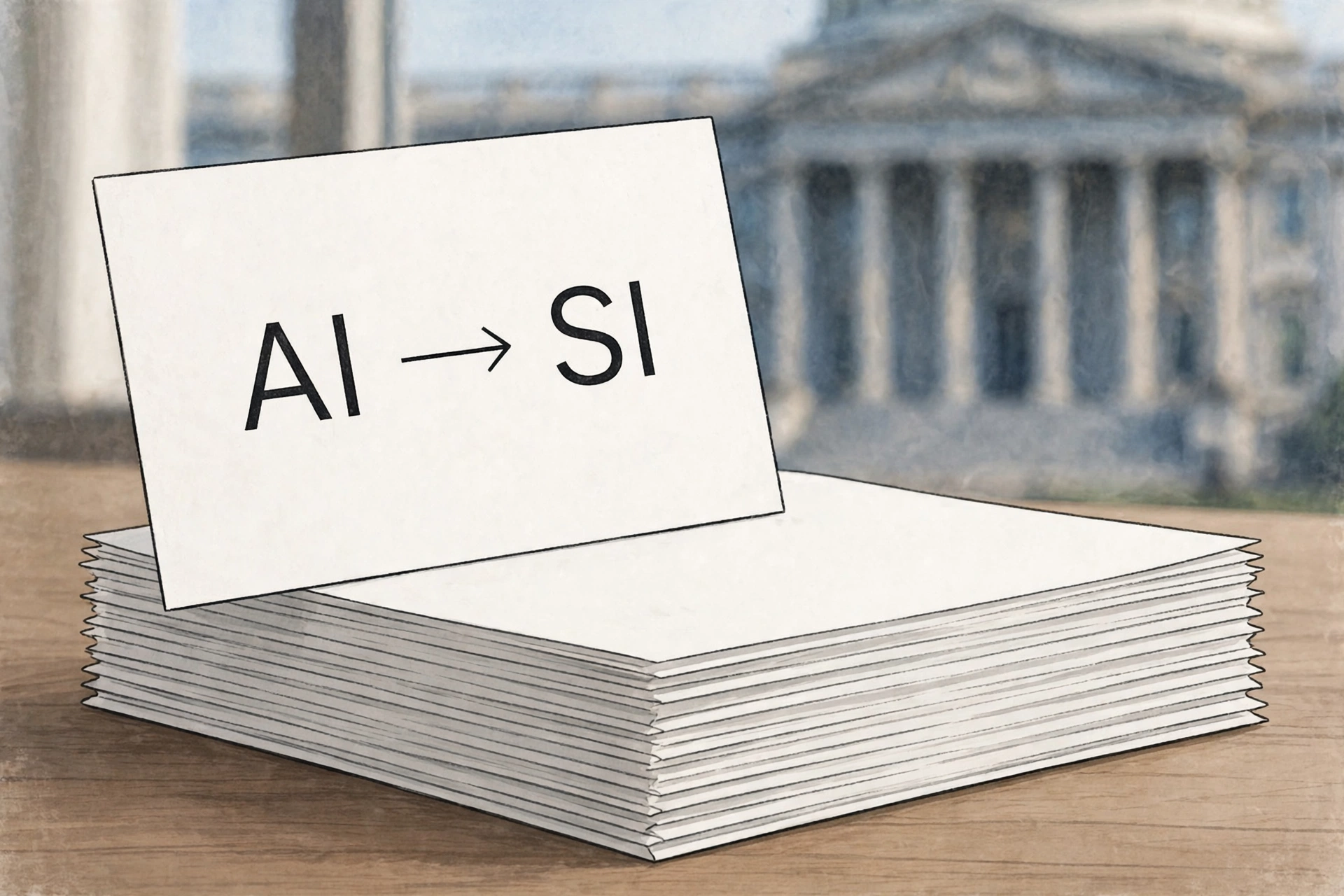
Hero image: an original generated symbolic illustration (a card reading "AI → SI" on blank papers), not a photograph of any person or any real government document. Quotations from the October 27 post are as reported by Reuters; the post itself created no new rule, and no effective date for a ban has been published.
Reader reviews
Loading reviews…