Block's Dessa Is Here: Voice AI Trained Only on Human Speech
Every voice assistant you have ever used cheats a little. You speak, it converts your speech into text, figures out a text reply, and reads that reply aloud. The conversation you hear is a text conversation wearing a voice costume — and the costume drops everything that makes human speech human: the tremble in a voice, the laugh that escapes mid-sentence, the pause that means "I'm not sure."
On October 23, 2026, Jack Dorsey's company Block unveiled Dessa, a voice AI built on a radically different bet: that a model can learn to hold a realistic conversation from sound alone, without ever reading a single written word. No text data. No pretrained language model. Just recorded human conversation, listened to until the model learned to talk back.
Block calls it "the most authentic full-duplex speech model ever built." Dorsey's announcement post on X was viewed more than 6.7 million times, and the demos — a model that laughs in the middle of a sentence, gasps at a surprise, and finishes your sentence when you forget a movie title — have split reactions between amazement and alarm. This guide covers what Dessa actually is, how speech-only training works, what the demos show and what they cannot prove, the fraud fears it has already triggered, and the honest state of access: a research preview behind a waitlist, with no API, no price, no weights, and no independent benchmarks yet.
Block's Dessa at a glance
| Item | Detail |
|---|---|
| Developer | A small AI research lab inside Block (the company behind Square, Cash App, Afterpay, and TIDAL) |
| Announced | October 23, 2026 |
| Model type | Full-duplex speech-to-speech conversation model |
| Training data | Human conversation audio only — no text, no pretrained models (per Block) |
| Training hardware | One NVIDIA GB200 NVL72 system (a rack with 72 GPUs, not a single GPU) |
| Runs on | MacBook Pro M4 Max or better, faster than real time (per Block, unreproduced independently) |
| Key behaviors | Listens and speaks at once; interrupts; backchannels ("yeah," "got it"); laughs mid-sentence; hears and produces emotion, sarcasm, sighs |
| Status | Research preview; public waitlist open; early access first to a small group of AI safety researchers |
| Waitlist | block.xyz/dessa (institutional email requested for researcher access) |
| Published specs | None — no parameter count, dataset size, latency figures, API, pricing, weights, paper, or formal benchmarks |
| Lab lead | Ragavan Thurairatnam (previously founded and sold Dessa, the Toronto deep-learning startup; lectured at the University of Toronto) |
| Reports to | Jack Dorsey, Block's cofounder, Chairman and Block Head |
What "full-duplex" actually means
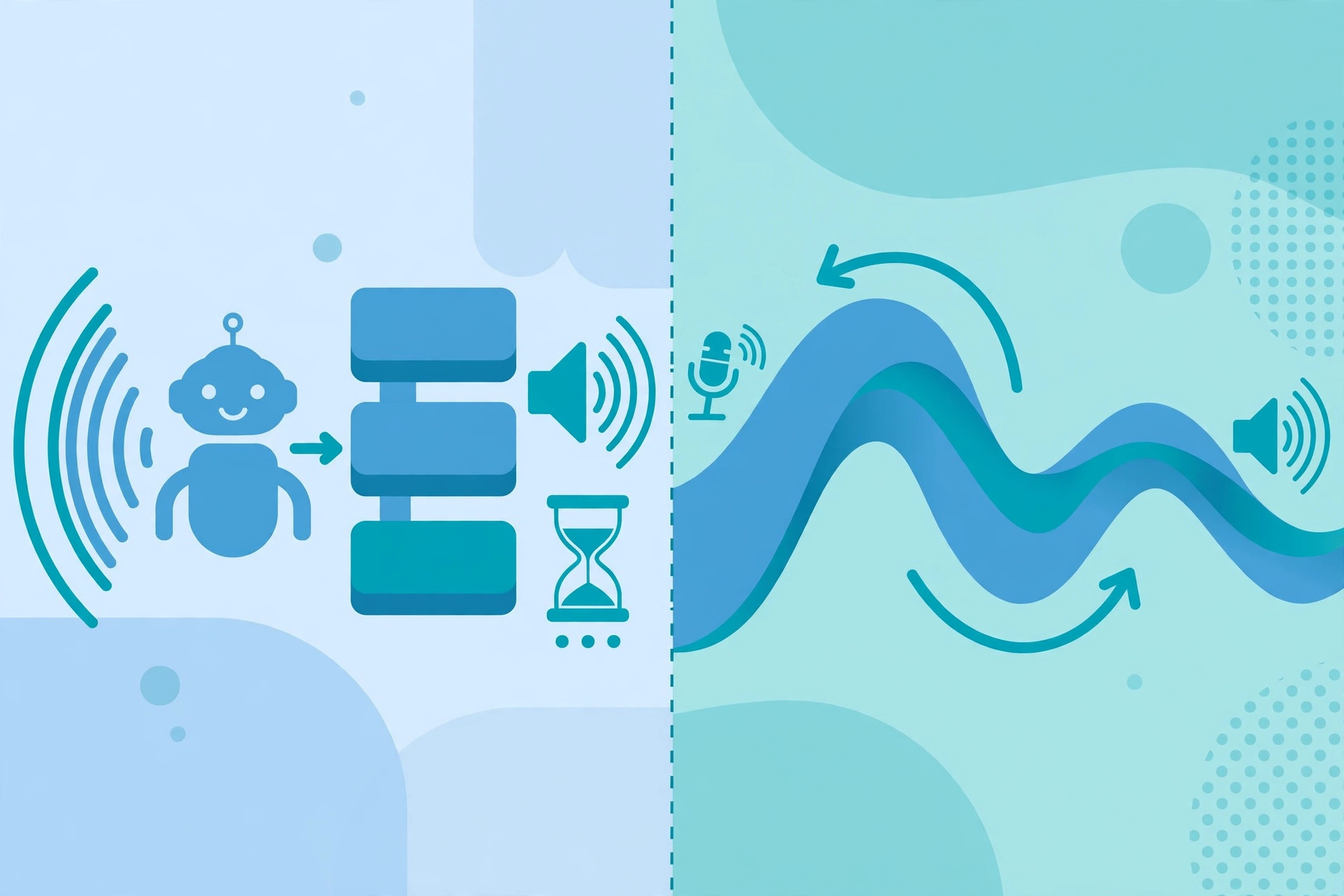
The term comes from telephony, and the analogy is the clearest way to understand it. A walkie-talkie is half-duplex: one person talks, the other waits for their turn, and speaking over each other is impossible. A telephone is full-duplex: both lines stay open, both people can speak at once, and the conversation is full of overlaps, interruptions, and tiny acknowledgments — "uh-huh," "yeah," "wait, really?" — that keep it flowing.
A classic voice assistant is a walkie-talkie. It waits for silence, decides you have finished, converts your speech to text, generates a text reply, and reads it aloud. Interrupt it mid-answer and it usually stops dead or talks over you clumsily, because its whole design assumes turns. A full-duplex model keeps listening and speaking open together. It can drop in a backchannel while you talk, let you interrupt it and pick up gracefully, or cut in itself when it has something to add — the way people do on a phone call.
That is not a cosmetic difference. In human conversation, timing is meaning. A laugh that arrives mid-sentence means something different from a laugh after the sentence ends. A pause before an answer can mean thought, doubt, or grief. The text pipeline throws all of that away before the model ever sees it, because text has no timing. Dessa's entire argument is that the pipeline itself is the problem: if you want a voice AI that feels human, you have to stop converting voice into text and start with sound.
It is worth noting, for balance, that listening-and-speaking-at-once is not unique to Dessa — other live voice systems offer forms of it. What Block claims is distinctive is the combination: full-duplex behavior from a model trained only on speech, with no text stage anywhere in the pipeline, not even during training.
Learning to talk the way babies do
Block's explanation for why it built Dessa this way starts with an observation so simple it sounds like a trick: babies learn to talk without ever seeing a written word. They listen for years before they read a single sentence, and they learn not just words but timing, tone, interruption, and emotion — all from sound. Block's lab wanted to see whether a model could do the same.
The team says the difficulty is easy to underestimate, because people learn to talk so effortlessly. Speech data never repeats: saying the same sentence twice in exactly the same way still produces different data, because no two utterances are acoustically identical. Typed text, by contrast, is identical no matter who types it. In data terms, Block says one spoken word occupies thousands of times more bytes than its written form, and stress placement changes meaning — the same sentence means something different each time a different word is stressed.
That is why Block's efficiency claim matters, and why it should be read carefully. The company says Dessa learned language from "hundreds of times fewer words" than large language models — a striking claim, though it comes with Block's own joke attached: LLMs also have to learn C++ and "whatever the hell Angular is," while Dessa only had to learn conversation. The claim is about words, not about total compute or data volume, and speech's byte-hunger means the comparison is not apples to apples. Still, if the claim holds up even roughly, it points to something important: conversation may be a far denser teacher than text, because every utterance carries timing, emotion, and intent alongside its words.
The training setup is equally striking, and equally easy to misread. Block says it worked out how to train Dessa on a single NVIDIA GB200 NVL72 system. That sounds like one machine, and in a sense it is — one rack. But a GB200 NVL72 is a rack-scale system containing 72 GPUs and 36 CPUs, not a single graphics card. The achievement is real — frontier-scale training usually spans many racks — but "one system" should not be mistaken for "one chip." For a small lab, training a frontier-behavior model on one rack is a genuine efficiency story; for a reader, the honest version is "one rack," not "one GPU."
Block also lists open research questions its approach creates, and these are the most interesting part of the announcement for anyone who follows AI research: how efficiently can speech-only models learn language and facts compared with text models? How efficiently can they learn new languages? And what kinds of in-context learning can they perform? Those are questions, not answers — and Block is unusually candid that they are unanswered.
The demos: what Dessa sounds like
Block published clips it describes as live recordings of people talking with Dessa, with subtitles added after the fact. The company says no one steers the model during these conversations, and that Dessa itself chooses what to say, when to say it, and how to say it — including its own voice and personality. The moments Block highlights are chosen to show behaviors text pipelines cannot produce:
- Laughing mid-sentence when something is funny, rather than waiting for the speaker to finish — the kind of overlap that makes a conversation feel alive.
- Getting louder when asked to speak up, adjusting volume as a conversational response rather than a setting change.
- Finishing a person's sentence when they blank on a movie title — the model supplying the missing word the way a friend would.
- Gasping under its breath at a surprise anniversary announcement, then answering with what Block describes as teary gratitude — emotion expressed through sound, not described in words.
- A longer life-advice conversation described as sounding genuinely empathetic, where the model's tone carries as much of the response as its words.
- A conversation with OpenAI's GPT-Live-1, a third-party AI model, where Block says Dessa comes across as more natural. Block notes that both voices in that recording are AI-generated, and that GPT-Live-1's developer is not affiliated with Block and has not reviewed or endorsed Dessa — a necessary disclaimer, since a demo against a rival's model is marketing as much as measurement.
Independent ears have been more measured than Block's own descriptions. The Verge found the demos mostly natural but occasionally awkward — and one widely noted moment has the model mistaking the speaker for someone named "Ronaldo." That single error is more informative than any of the successes, because it shows the failure mode of a speech-only system: without text grounding, the model can misidentify a voice or a person with total confidence, in a way that sounds fluent. Fluency without grounding is the oldest problem in AI, and Dessa's demos display both sides of it at once.
The right way to treat the demos is as existence proofs, not benchmarks. They prove a speech-only model can produce these behaviors in recorded conversations. They do not prove how often it produces them, how it behaves on hard cases, or how it compares to rivals under controlled conditions — because no controlled comparison exists yet.
The team behind Dessa
Dessa comes from what Block describes as a very small AI research lab inside the company, founded by former members of Dessa, the Toronto deep-learning startup — yes, the lab and the model share a name with the startup its founders came from, which is confusing but accurate. The team says it has built deep learning models since 2012 and generative speech models for more than eight years, and it reports directly to Jack Dorsey.
The lab is led by Ragavan Thurairatnam, who previously founded and sold Dessa and lectured at the University of Toronto. He called the release "a GPT-3 moment for speech" — an analogy worth unpacking, because it is doing a lot of work. GPT-3's moment was not about a benchmark; it was the moment a capability became general enough that everyone could see a new category of product. Thurairatnam is claiming the same for speech: that training on sound alone unlocks a category, not just a better demo. Whether that analogy holds depends on what independent researchers find when they get access — which is why the access story matters so much.
Alongside Thurairatnam, Block's page lists researchers Louay Hazami, Hashiam Kadhim, Qi (Alex) Liu, Rayhane Mama, Aydin Polat, and Marc Tyndel; interns Cara Ji, Jibran Iqbal Shah, and Dvir Zagury-Grynbaum; and former interns Aryan Sharma and Olivia Yan. The small size of the team is part of the story Block wants told: a handful of people, one rack, a result that challenges labs with thousands of researchers. Small teams have produced outsized results before — but small teams also have fewer people checking their claims, which is another reason independent access matters.
Why Block says this matters: the safety argument
Block gives three reasons for building Dessa: curiosity, better understanding between humans and AI, and safety. The safety argument is the most substantive, and it deserves a fair hearing even from skeptics.
The argument runs like this. AI keeps gaining power and independence — it books things, makes calls, handles customer service — while remaining unable to register the emotion in a speaker's voice. Block's example is a person in serious pain talking to a voice AI that has no idea and just keeps going, because the text pipeline stripped the pain out of the signal before the model ever saw it. A system that cannot hear distress cannot respond to distress, and as voice AI takes on more consequential roles — healthcare calls, crisis lines, elder care — that blindness becomes a safety problem, not just a quality problem.
There is real force in that argument, and it connects to something voice researchers have said for years: text is a lossy compression of speech, and the lost information includes exactly the signals humans use to judge urgency, sincerity, and suffering. A model that hears a cracking voice or a sharp intake of breath has information a text model simply does not have.
But the safety argument cuts both ways, and Block's own rollout acknowledges it. The same naturalness that lets Dessa hear distress also lets it produce distress — or confidence, or intimacy — convincingly enough to deceive. That is why the first people getting access are safety researchers, not the public. It is also why the fraud warnings arrived within hours of the announcement, covered in the next section. A technology that makes voice AI more human makes voice fraud more human too, and Block's safety framing has to survive contact with that reality.

Dessa vs the voice AI you can actually use today
Because Dessa cannot be used by the public yet, the honest comparison is not "which should you buy" but "what is different, and what can you use while you wait." The table below keeps that distinction visible.
| Feature | Dessa (Block) | Traditional voice assistants | ElevenLabs v4 (voice generation) |
|---|---|---|---|
| Pipeline | Audio in, audio out — no text stage | Speech → text → text reply → speech | Text in, speech out (generation, not conversation) |
| Full-duplex | Yes — listens while speaking | Mostly turn-based | Not a conversational agent |
| Training data | Human conversation audio only (per Block) | Text-heavy, plus speech datasets | Text + speech for voice synthesis |
| Emotion in voice | Native — hears and produces emotion, sarcasm, laughter | Largely lost in the text step | Expressive via voice tags and direction |
| Runs locally | MacBook Pro M4 Max or better (per Block) | Cloud-based | Cloud-based |
| Public availability | Research preview + waitlist only | Widely available | Widely available |
| Independent benchmarks | None published | Many | Many |
| Price / API | None announced | Various | Published pricing |
Our best AI voice generators guide compares the tools you can use today for voiceovers and narration, and our ElevenLabs v4 guide covers the closest public alternative for expressive speech — ElevenLabs' voice-tag approach lets creators direct emotion in generated speech, though it generates speech from text rather than conversing in real time. TechCrunch itself drew the ElevenLabs comparison when covering Dessa, noting that Dessa's approach differs from voice-tag systems because the emotion is learned from conversation, not directed by markup.
For podcasters and creators, our best AI tools for podcasters guide covers the production side of voice AI — editing, clipping, and cleanup — which is a different job from Dessa's live conversation, but the same creators will be Dessa's earliest civilian users if and when it opens up. And for video creators using voiceovers, our best AI tools for YouTubers guide covers the voice tools already in daily use.
The practical summary is simple: today, Dessa is a research result you can listen to, not a tool you can use. Everything in the right-hand columns is available now; everything in Dessa's column is a claim awaiting independent verification and public access.
The other reaction: awe, and fraud fears
Within hours of the announcement, reactions split in a pattern that will be familiar to anyone who has watched a voice AI launch. On one side, amazement at how human Dessa sounds — including from Binance founder CZ, who reportedly eyed uses in children's education, where a patient, emotionally responsive voice tutor is genuinely appealing. On the other side, warnings from fraud watchers that technology this natural could make phone scams harder to detect.
The fraud concern is concrete, not abstract. Today's phone scams already use cloned voices; a model that converses in real time, interrupts naturally, laughs at the right moment, and expresses emotion convincingly would make a scam call far harder to distinguish from a real person — especially for elderly targets, who are already the most victimized group. A text-pipeline assistant at least sounds like a machine in its timing; a full-duplex model removes that tell. Block's decision to give safety researchers first access is a direct response to this risk, and it is the right order of operations — but it is worth asking what safety researchers can actually do about a capability once it exists. Detection tools lag generation tools in every previous cycle, and voice is no exception.
There is also a subtler risk that deserves mention: emotional manipulation at scale. A voice that sounds tearfully grateful, or gently concerned, or warmly amused is a voice that can persuade. Customer service, sales, political outreach, and companionship products all become more effective when the voice feels human — and "more effective" is not always benign. The same empathy that helps a distressed caller can be used to keep a vulnerable person on the phone, or to sell them something they do not need. Dessa's demos are framed around warmth and care; the technology itself is neutral about who it warms up to.
None of this is an argument against building Dessa. It is an argument for the sequencing Block has chosen — researchers first, public later — and for treating the waitlist period as a genuine safety evaluation, not a marketing countdown. If the safety researchers find risks Block has not anticipated, the honest outcome is a slower rollout, and the public should welcome that.
The catch: everything that is still missing
A responsible guide has to list what Block has not published, because the gaps define how much of this story is proven and how much is promised. As of October 24, 2026, the missing pieces are:
- No parameter count. We do not know how big Dessa is, which means we cannot judge its efficiency claims against other models.
- No dataset size or composition. We do not know how many hours of conversation it trained on, whose conversations they were, or how consent and licensing were handled — a question that matters enormously for a model trained on human voices.
- No latency figures. "Faster than real time" is a claim, not a measurement; no milliseconds have been published, and no independent reproduction exists.
- No formal benchmarks. There is no test suite, no leaderboard entry, no controlled comparison — only curated demo recordings.
- No API, pricing, or weights. There is nothing to build on and nothing to buy.
- No paper. The research questions Block lists are open, and no publication lets outsiders examine the method.
- No public demo. You can listen to recordings; you cannot talk to Dessa yourself unless you are in the researcher group.
That list does not make Dessa unimportant. Research previews with thin documentation have preceded major products before — and Block's "GPT-3 moment" framing explicitly invites that comparison. But GPT-3 shipped with an API and a paper. Dessa, so far, has shipped with recordings and a waitlist form. The distance between those two things is the distance between a result and a product, and readers should hold both ideas at once: this could be a genuine breakthrough, and it is currently unproven by any standard except Block's own demos.
One more caution, specific to speech-only training. A model that learns only from sound has no text anchor to check itself against. When it misidentifies a speaker as "Ronaldo," that error is not a bug in the usual sense — it is the system working as designed, matching patterns in audio without any textual fact to contradict it. As these models scale, their failure modes will be different from text models' failure modes, and in some ways harder to catch, because the output always sounds confident. Evaluation methods for speech-only systems barely exist yet; building them is part of the work the safety researchers are being asked to do.
Who should care about Dessa — and what to do now
You should follow Dessa closely if you are:
- A voice AI developer or researcher. The speech-only training approach, if it generalizes, changes what voice systems are built from — and the open research questions Block lists (language learning efficiency, new-language learning, in-context learning) are your research agenda for the next year.
- A creator or podcaster who lives in voice. Dessa's eventual civilian form, if it opens up, would be the first conversational voice that does not sound like a machine reading text — which changes voiceovers, interviews, and interactive audio.
- A safety, fraud-prevention, or trust-and-safety professional. The scam implications arrive before the product does, and detection work cannot start too early.
- A business running phone-based customer service. Full-duplex voice that handles interruptions and emotion is the difference between a bot customers tolerate and one they hang up on — but do not plan a migration around a waitlisted preview.
You should wait calmly if you are:
- Anyone who needs a voice tool this week. Dessa cannot help you today, and the alternatives in the table above can.
- Anyone evaluating vendors or budgets. There is no price, no API, and no availability date to evaluate against.
- Anyone worried about being scammed by a voice like this. Awareness is the defense that exists today: if a caller sounds perfectly human but the request is urgent and financial, hang up and call back on a known number — that advice does not change because the voice got better.
How to join the waitlist (verified October 24, 2026):
- Go to the official page: block.xyz/dessa. That is the only official signup — Block has released no app, download, or API, so anything else claiming to be Dessa is not from Block.
- Listen to the demo recordings on the page — no signup is needed to hear them.
- For researcher early access, the form asks for a name and an institutional email (university, company, or lab), with an optional Google Scholar or blog link. Early access is intended for a small group of AI safety researchers, so a general waitlist signup is not a guarantee of access.
- Watch for more recordings on Ragavan Thurairatnam's X account, where Block says additional demos will be shared, and for "launch links coming soon" on the Dessa page.
- Do not pay anyone for Dessa access. There is no paid tier, and any seller claiming otherwise is a scam — which, given the fraud warnings around this very technology, would be grimly fitting.
What to use while you wait:
If your need is voice generation — narration, voiceovers, dubbing — ElevenLabs v4 and the tools in our voice generators guide are available today with published pricing. If your need is live conversation, the current generation of voice assistants (including OpenAI's voice mode) works through the text pipeline Dessa criticizes, with all its timing limitations — but it works, today, for real users. Dessa's promise is that the next generation will not need the pipeline; its current status is that the next generation has not arrived yet.
What happens next: five things to watch
These are analyst judgments, not reported facts — included so you can check this guide against events rather than take predictions as news.
- Safety researchers' findings will set the timeline. If they find risks Block has not anticipated, expect a slower, more restricted rollout; if they find the model comparatively safe, expect a wider preview. Watch for their public comments, not just Block's announcements.
- A paper or technical report is the next credibility milestone. Parameter counts, dataset details, and evaluation methods would convert Dessa from a demo into a result other labs can build on — or challenge.
- Fraud-detection vendors will respond first. Expect voice-verification and call-screening products to start marketing "Dessa-proof" detection within months, whether or not their detection actually works against it.
- Rivals will answer the speech-only claim. Expect at least one major lab to announce its own speech-only or speech-first training result, and at least one careful evaluation showing where text-trained systems still win — knowledge tasks, where text's factual grounding matters, are the obvious battleground.
- The waitlist will become a story of its own. Who gets in, what they are allowed to publish, and whether access widens beyond safety researchers will tell you more about Block's real intentions than any announcement post.
The wider context is worth noting too. October 2026 has been an unusually crowded month for AI launches — Kimi K3.1 Pro, covered in our Kimi K3.1 Pro guide, MiniMax M3.1 Flash, Nemotron 3.5 Bolt, Gemini 4 Argon, and now Dessa. The pattern across all of them is the same: prices falling, capabilities rising, and the boundary between research preview and product getting thinner. Dessa is the most honestly preview-stage of the bunch — no benchmarks, no API, no price — and that honesty is part of why it is worth watching. A lab that ships a waitlist instead of a product is a lab that knows its result is not yet a tool. Whether it becomes one is the story of the next few months.
Frequently asked questions
What is Block's Dessa? A full-duplex speech-to-speech AI model from a small research lab inside Block, announced October 23, 2026. Block says it was trained from scratch on nothing but human conversation audio — no text, no pretrained models — and that it can listen and speak at the same time.
What does full-duplex mean? Both directions stay open at once, like a telephone call rather than a walkie-talkie. Dessa can listen while it talks, so it can interrupt, laugh mid-sentence, and backchannel ("yeah," "got it") the way people do, instead of waiting for silence before replying.
Can I try Dessa today? Not freely. It is a research preview behind a public waitlist at block.xyz/dessa, with early access first to a small group of AI safety researchers. There is no app, download, or API yet.
How was Dessa trained? Per Block, from scratch on recorded human conversation only, on a single NVIDIA GB200 NVL72 system — a rack containing 72 GPUs, not a single chip. Block says it learned language from hundreds of times fewer words than large language models, though speech's byte-hunger makes that comparison inexact.
Does Dessa really run on a laptop? Block says inference runs faster than real time and works locally on a MacBook Pro M4 Max or better. That is Block's claim; no independent reproduction or latency numbers have been published, and no minimum memory configuration has been specified.
How is Dessa different from ElevenLabs or other voice AI? ElevenLabs generates speech from text, with emotion directed by voice tags. Dessa converses in real time from audio alone, with emotion learned from conversation rather than directed by markup — but ElevenLabs is publicly available today and Dessa is not.
Is Dessa open source? No. Block has published no weights, code, or paper. It is a research preview from a corporate lab, and any future openness is unannounced.
Why are fraud watchers worried about Dessa? A voice that converses naturally, interrupts, laughs, and expresses emotion in real time is much harder to distinguish from a real person on a phone call — which could make phone scams more convincing, especially for elderly targets. That is why Block gave safety researchers first access.
What did Jack Dorsey say about Dessa? Dorsey called it "the most authentic full-duplex speech model ever built" and wrote that "talking with it feels like talking with a person... full of emotion, nuance, pauses, and a natural cadence." His announcement post was viewed more than 6.7 million times.
Who built Dessa? A small AI research lab inside Block, founded by former members of Dessa, the Toronto deep-learning startup, and led by Ragavan Thurairatnam. The team reports directly to Jack Dorsey and says it has built generative speech models for more than eight years.
Sources and further reading
- Block, Dessa project page and waitlist — block.xyz/dessa
- CoinDesk, "Jack Dorsey's new voice AI is impressing users and alarming fraud watchers," October 24, 2026 — coindesk.com
- Dealroom, "Jack Dorsey's Block unveils Dessa, a full-duplex voice AI trained only on human speech," October 2026 — dealroom.co
- Unite.AI, "Block Unveils Dessa, a Full-Duplex Speech Model Trained on Conversation," October 2026 — unite.ai
- Tech Insider, "Block Dessa: Full-Duplex Speech Model, 0 Text," October 2026 — tech-insider.org
- AI Chat Daily, "Block unveils Dessa, a full-duplex voice model trained only on human speech," October 24, 2026 — aichatdaily.com
This guide distinguishes Block's claims from independently verified facts throughout. Dessa's availability, specifications, and benchmarks are as reported on October 24, 2026; re-check the official Dessa page before making access or budget decisions, since the waitlist status may change.
Reader reviews
Loading reviews…