ElevenLabs v4: What It Is, What It Costs, and Who Should Switch
By ToolPilot Pro · Updated 2026-10-14 · Audio
#audio#elevenlabs v4#eleven v4 turbo#expressive text to speech#ai voice generator#elevenlabs pricing#text to speech with emotion#ai voice cloning#voice ai agent
ElevenLabs v4: What It Is, What It Costs, and Who Should Switch
On September 28, 2026, ElevenLabs shipped the biggest update to its voice models in two years: Eleven v4, a text-to-speech model you direct with written instructions instead of settings panels, and Eleven v4 Turbo, a low-latency sibling built for real-time voice agents. Two days later, the company closed a $300 million employee share sale that valued it at $22 billion — double its February valuation. The voice-AI business is no longer a side bet. It is the main event.
I spent the days since launch reading ElevenLabs' announcement materials, the independent coverage, and the hands-on reports from developers who have already wired v4 into their apps, separating what is genuinely new from what is marketing gloss. Here is the honest version: what v4 does differently, what it costs now that the launch discount has ended, where it ranks against the competition, and who should actually switch.
What Actually Launched on September 28
Two models, aimed at two different jobs.
Eleven v4 is the flagship for anything a listener hears later: audiobooks, character voiceovers, multi-speaker dialogue, dubbing, narration. ElevenLabs calls it the company's highest-quality model, and the practical headline is reliability over long generations — the model holds a speaker's identity steady across a 10,000-character request, roughly ten minutes of audio. Version 3 capped out at half that length, and long narrations were where it occasionally drifted off-voice.
Eleven v4 Turbo is the real-time sibling for voice agents, assistants, and interactive characters. ElevenLabs quotes a median inference latency of about 100 ms and a median time to first speech of about 150 ms. Independent testing by one developer blog clocked Turbo starting a short sentence in about 90 ms, against roughly 256 ms for the v3 conversational model — fast enough that the agent can start answering inside the natural pause between two people talking.
Both models are live now across ElevenLabs' three surfaces: ElevenAgents (the conversational-agent platform), ElevenCreative (the studio tools), and the ElevenAPI. They speak more than 90 languages, up from more than 70 on v3, and the biggest reported quality jumps are in Japanese, Brazilian Portuguese, Mandarin, and Cantonese, per TechCrunch's coverage of the launch.
The Audio Tags: Directing a Voice Like an Actor
This is the feature that changes how you write for synthetic voice, so it deserves the full explanation.
Older TTS models take text and a bundle of settings — pick a voice, set stability and similarity sliders, maybe add SSML prosody tags — and you get whatever the model decides "expressive" means. Eleven v4 inverts the relationship: the script itself is the mixing desk. You write direction inline, in plain language, and the model performs it.
A line can look like this: [laughs] I cannot believe that actually worked. The model laughs, then delivers the line. [whispers] they are right behind us comes out whispered. [speaks angrily with a British accent] does exactly what it says. Sound effects work too — [light rain sound], [cellphone vibration] — and so do free-form directions that no preset could cover.
Three things make this more than a gimmick. First, the model acts the tags out instead of reading them aloud, which sounds obvious until you learn that older ElevenLabs models (Flash v2.5, Multilingual v2) will cheerfully speak the word "laughs" mid-sentence. Second, multi-speaker dialogue now responds to what was just said — characters react to each other instead of reading isolated lines, which is the difference between a table read and a scene. Third, pronunciation got a real upgrade: better IPA handling means unusual names and foreign words come out right more often.
There are rules worth knowing before you write your first tagged script. Place each tag immediately before the words it changes. If you are generating dialogue with an LLM feeding the voice model, tell the LLM in its system prompt which tags it is allowed to write — otherwise it will invent tags the voice model was never taught. And budget for the tags: every tag character is billed the same as a spoken-word character, so a heavily directed script costs measurably more than a plain one.
The honest trade-off: if your existing pipeline leans on SSML prosody tags for pacing and emphasis, you will need to rewrite that direction as natural-language audio tags. It is more work up front. The payoff, according to early hands-on reports, is that v4 follows natural-language direction far more consistently than most TTS engines ever honored SSML.
Eleven v4 Turbo: Built for Real-Time Conversation
Turbo exists for one reason: voice agents cannot wait.
A conversational agent that takes half a second to start speaking feels broken — humans interpret the gap as confusion. Turbo's ~100 ms median inference latency and ~150 ms time to first speech put it inside the natural rhythm of turn-taking. It performs the same audio tags as the flagship, so an agent can [sigh] before delivering bad news or drop into a whisper for an aside, and it speaks the same 90+ languages, which matters for companies deploying one agent across markets.
Two practical details for developers. First, the model IDs are eleven_v4 and eleven_v4_turbo, and both stream over the Text to Dialogue WebSocket (wss://api.elevenlabs.io/v1/text-to-dialogue/stream-input) with the model ID as a query parameter. ElevenLabs serves v3 and v4 only on that endpoint — point the old TTS WebSocket at v4 and you get an HTTP 400 unsupported_model telling you to switch. The endpoint also takes the voice in its first message rather than the URL and expects text in an inputs array, so the client code changes along with the URL. Second, each API call holds one dialogue session for its whole length, and your plan caps how many v4 calls run concurrently — 70 on Pro, 105 on Scale. Size your plan for peak concurrency, not average.
What It Costs Now That the Launch Discount Is Over
Let us be precise, because the pricing page changed while everyone was reading the launch coverage.
The API list prices are $80 per million characters for Eleven v4 and $40 per million for v4 Turbo. For two weeks after launch, a 72% discount cut those to $22 and $11 — that offer ran through October 12, 2026. Unless ElevenLabs extends it, the prices you see on the pricing page now are the list prices. The per-character price is the same on every plan; what changes by plan is how many concurrent sessions you can run.
On the subscription side, both models are included on every tier, including Free — a notable choice, since flagship models are usually paywalled. The Free tier's 10,000 monthly credits are enough to evaluate the quality (a few minutes of audio) but not to run anything real. The Creator tier at $22 per month gets 121,000 credits, roughly two hours of narration, and v4 is available in the creative suite for Creator plans and above at up to 2x monthly credits.
For context on what the list price buys: at $80 per million characters, v4 is priced as a premium model. Artificial Analysis' leaderboard lists Cartesia's Sonic 3.6 at $49 per million and Google's Gemini 3.8 Flash TTS at $16.50. You are paying for the top-ranked voice and the tag-directed expressiveness; whether that premium is worth it depends on whether your listeners can hear the difference in your use case.
The $22 Billion Valuation
Two days after the model launch, ElevenLabs closed a $300 million employee tender offer that valued the company at $22 billion — double the $11 billion attached to its $500 million Series D in February 2026. The deal was led by Wellington Management and T. Rowe Price, with first-time investors including EQT, Goldman Sachs, GIC, and Sapphire Ventures alongside existing backers like Andreessen Horowitz and Lightspeed.
The accounting matters more than the headline. A tender offer is a secondary sale: employees and existing shareholders sold shares to the new investors. None of the $300 million went onto the company's balance sheet as operating capital. What the price does signal is where sophisticated money thinks voice AI is going — and the company's numbers explain the enthusiasm. Enterprise now accounts for 55% of revenue, the platform handles more than 15 million conversations a week (about triple February's level), and ElevenLabs says its technology is in daily operation at five of the world's ten largest tech companies.
The valuation also explains the product strategy. ElevenLabs started as a TTS API for creators; it is now selling conversational agents that handle refunds, insurance renewals, and appointment bookings inside enterprises. Eleven v4 Turbo, with its sub-conversation-turn latency, is the model that strategy needed.
Where It Ranks
On the Artificial Analysis Speech Arena — the blind-vote leaderboard where listeners pick winners without knowing which model they heard — Eleven v4 ranks #1 with an Elo of 1319, a clear 43 points ahead of Cartesia's Sonic 3.6 at 1276. Google's Gemini 3.8 Flash TTS sits third at 1267.
ElevenLabs separately claims roughly 75% listener preference in its own head-to-head tests against Cartesia, Inworld, and two Gemini TTS models. That number comes from the company's own testing, not a third party — file it as a vendor claim until independent ears confirm it. The Speech Arena ranking, which ElevenLabs does not control, is the stronger evidence, and it agrees: v4 is currently the voice to beat.
ElevenReader Gets v4 Too
The launch was not API-only. In a September 30 post updated October 2, ElevenLabs moved v4 into ElevenReader, its reading app for PDFs, ebooks, articles, documents, and web content. Narration is more expressive, text-to-speech coverage jumped from 32 to more than 90 languages, and the update is available on the Free plan.
The Reader has its own pricing: Free includes 10 hours of text-to-speech uploads per month, and an Ultra plan at $11 per month adds unlimited text-to-speech, offline mode, and human-narrated audiobooks. For listeners rather than builders, this is the cheapest way to hear what v4 can do — and long-form listening is exactly where v4's speaker-consistency improvements matter most.
What This Means for You
If you narrate long content — audiobooks, courses, video essays — v4 is the most interesting upgrade. The 10,000-character request limit and steadier speaker identity attack the exact failure mode (voice drift over long sessions) that made long-form TTS feel cheap. Test it on your longest chapter before committing; that is where v3 fell down.
If you build voice agents, Turbo's latency is the story, and the migration notes above are your checklist: new WebSocket endpoint, tags in the system prompt, concurrency sized to your plan. The ~90 ms independent measurement is genuinely best-in-class for an expressive model.
If you are on v3 or Multilingual v2, the switch is not free. Tagged scripts replace SSML workflows, the API endpoint changes, and tag-heavy scripts cost more per character than plain ones. Budget the rewrite before you promise a launch date.
If you are choosing a first TTS provider, start with the Free tier and judge by ear on your own scripts — preferably dialogue with direction tags, since that is where v4's advantage is largest. Our roundup of the best AI voice generators puts ElevenLabs head-to-head with Murf, PlayHT, Speechify, and the rest on quality, pricing, and free plans. Podcasters should also see our AI tools for podcasters guide, and video creators using voiceover plus dubbing will find v4 relevant to the workflows in our AI video generators roundup.
If you are price-sensitive, the honest math is that v4 is a premium model at list price. The launch discount is over; if your workload is high-volume and plain narration, the cheaper leaderboard models deserve a listening test before you default to the top rank.
Frequently Asked Questions
What is ElevenLabs Eleven v4?
Eleven v4 is ElevenLabs' flagship text-to-speech model, launched September 28, 2026. It generates expressive speech from text, follows inline audio tags for delivery and emotion (like [laughs] or [whispers]), speaks 90+ languages, and clones a voice from 10 seconds of audio. It is available in ElevenAgents, ElevenCreative, and the ElevenAPI.
What is the difference between Eleven v4 and v4 Turbo?
Eleven v4 is the highest-quality model, built for narration, dubbing, and dialogue you listen to later. Eleven v4 Turbo is a lower-latency version (~100 ms median inference) built for real-time voice agents and interactive characters. Turbo performs the same audio tags and speaks the same 90+ languages.
How much does Eleven v4 cost?
The API lists Eleven v4 at $80 per million characters and v4 Turbo at $40 per million. A 72% launch discount ($22 and $11) ran through October 12, 2026. Both models are included on every subscription tier including Free (10,000 monthly credits); the Creator plan at $22/month includes 121,000 credits.
Do the audio tags cost extra?
Tags are not a separate fee, but every tag character is billed the same as a spoken-word character. Heavily directed scripts cost measurably more than plain text at the same word count.
Can I use Eleven v4 on the free plan?
Yes. Both v4 and v4 Turbo are available on the Free tier with 10,000 monthly credits — enough to evaluate quality on your own scripts, not enough for production workloads.
Does Eleven v4 work with my existing v3 code?
Not directly. ElevenLabs serves v3 and v4 only on the Text to Dialogue WebSocket; the older TTS WebSocket returns an error for v4. You will need to update the endpoint, pass the voice in the first message, and send text in an inputs array.
The Bottom Line
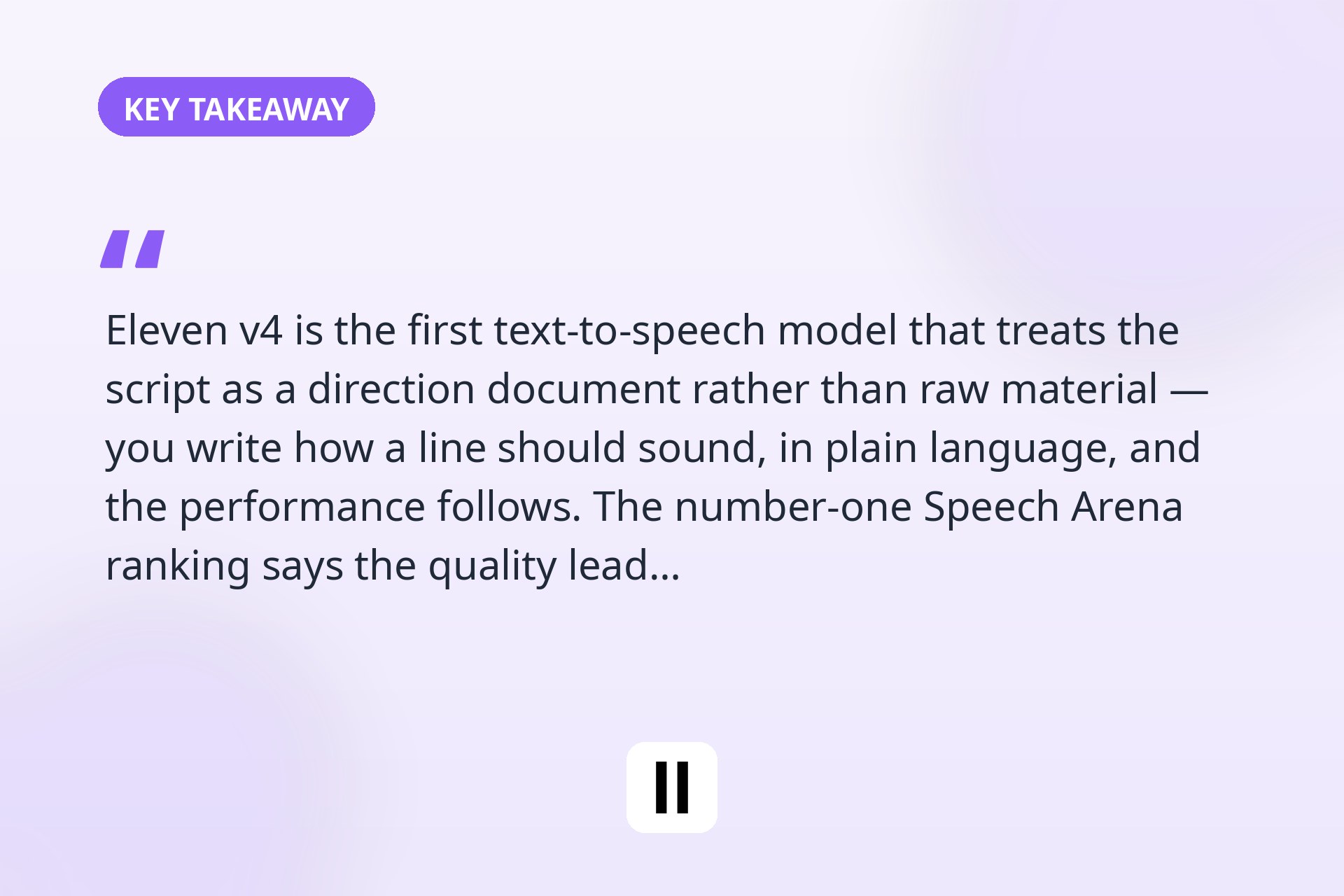
Eleven v4 is the first text-to-speech model that treats the script as a direction document rather than raw material — you write how a line should sound, in plain language, and the performance follows. The number-one Speech Arena ranking says the quality lead is real, the Turbo variant finally makes expressive voices fast enough for live conversation, and the 90-language coverage plus 10-second cloning remove the two biggest practical barriers to multilingual voice work.
The caveats are the price at list rates, the migration work for existing v3 pipelines, and the billing reality that directed scripts cost more character-by-character. None of that changes the verdict: if voice quality is the thing your product sells, v4 is the current benchmark, and the $22 billion valuation says the market agrees.