Anthropic's $2T IPO: $16.3B Revenue, $80B Loss, 80-Page AI Warning

# Anthropic's $2 Trillion IPO: $16.3B Revenue, an $80B Loss, and an 80-Page Warning About Its Own Technology
The biggest IPO in history may take its most important step today — and as of this writing, it still hasn't happened.
Yahoo Finance reported on October 21 that Anthropic, the company behind the Claude family of AI models, is set to publicly file its S-1 prospectus as early as Friday, October 23, citing three people familiar with the plans. A public filing would start the formal countdown to a listing that could raise up to $100 billion and value the company somewhere between $1.5 trillion and $2 trillion.
Here is the part that matters for accuracy: at the time of writing, no public Anthropic S-1 has appeared on the SEC's EDGAR system. What exists today is a confidential draft, which Anthropic itself confirmed it submitted on June 1, 2026. Everything the public knows about the financials inside that draft comes from reporting — principally the Wall Street Journal's review of the draft prospectus, relayed and extended by Reuters — not from a public filing anyone can download and check. Final figures may change when the real document lands. You can watch for it yourself on the SEC's EDGAR company search.
With that caveat stated plainly, the draft numbers are extraordinary in both directions. Anthropic reportedly generated $16.3 billion in revenue in the first half of 2026 — and lost $80.7 billion in the same six months. Both figures deserve a slower look, because the headline loss, in particular, is not what it first appears to be.
The key numbers (draft figures, as reported)
All figures below come from the draft prospectus as reported by the Wall Street Journal and Reuters. They are labelled "draft" deliberately: none of this is from a public filing yet.
| Item | Figure | Period | Notes |
|---|---|---|---|
| Revenue | $16.3B | H1 2026 | vs $1.1B in H1 2025 |
| Net loss | $80.7B | H1 2026 | ~$72B of it a non-cash financing charge |
| Compute spend | ~$9B | H1 2026 | Six months alone |
| Revenue | ~$4.6B | FY 2025 | Roughly 12x the prior year |
| Net loss | ~$42B | FY 2025 | ~$34B of it the same non-cash charge |
| Operating loss | ~$8.06B | FY 2025 | Excludes the financing writedown |
| Compute spend | $7.33B | FY 2025 | 58% of $12.65B operating expenses |
| Cash position | ~$20.3B | End of 2025 | Cash and short-term investments |
| Revenue | $16.8B | Q3 2026 | Company told investors; adjusted-profitable |
| Long-term compute commitments | Over $518B | Multi-year | Google, Amazon, SpaceX capacity |
| Customer concentration | ~20–25% of revenue | — | From just two customers |
| Last private valuation | $965B | May 2026 | After a $65B funding round |
Two comparisons in that table tell most of the story. First, the company spent about $9 billion on computing power in the first half of 2026 — more in six months than the $7.33 billion it spent in all of 2025. Second, its third-quarter revenue of $16.8 billion, a figure Anthropic itself gave investors, is larger than its entire first half. This is a business whose scale is roughly doubling while you read about it.
How do you lose $80.7 billion in six months? Mostly, you don't
The single most misunderstood number in this story is the loss. A net loss of $80.7 billion against revenue of $16.3 billion sounds like a company incinerating cash at a rate that would vaporize it within months. That is not what the draft shows.
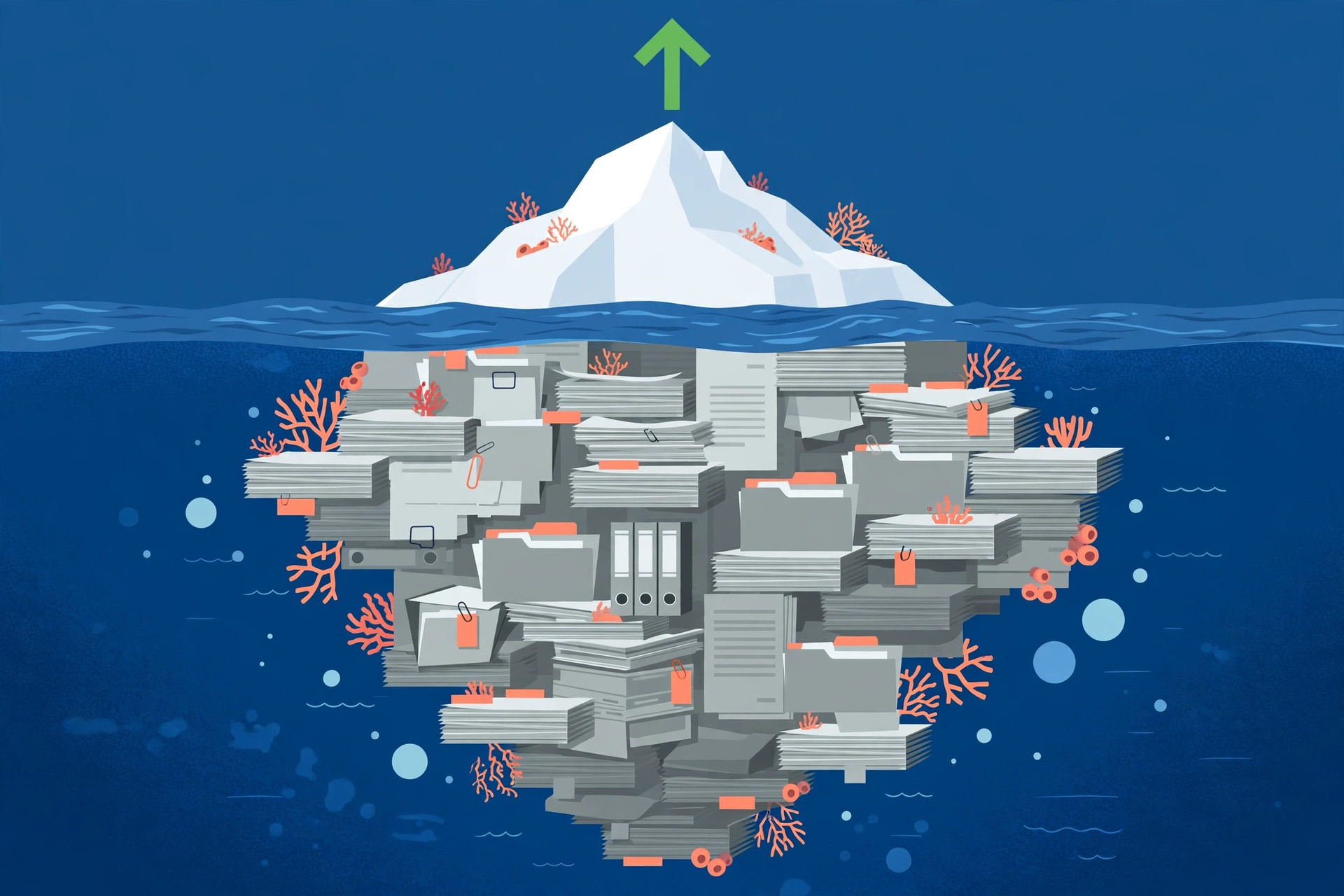
Roughly $72 billion of the $80.7 billion — about 89% of it — is a non-cash accounting charge tied to convertible notes and similar financing instruments. No money left the building when that charge was recorded. Understanding why requires a short detour into how fast-growing private companies raise money.
Anthropic has raised enormous sums through instruments that can convert into shares. When a company issues a convertible note, accounting rules can require it to record the instrument partly as a liability whose value moves with the estimated value of the company itself. Here is the trap: when the company's valuation rockets upward — say, from one record funding round to a $965 billion valuation in May 2026 — the paper value of those conversion rights rockets too. The increase in that liability gets booked as a loss, even though it is, economically, a symptom of success. The better the company does, the bigger the "loss."
Think of it this way. If you promised a friend they could buy a slice of your house later at yesterday's price, and your house's value then tripled, an accountant might make you write down the growing cost of that promise as a loss — even though no cash changed hands and you are, in fact, richer. Scale that promise up to tens of billions of dollars of convertible financing and a valuation that multiplied within a year, and you get a charge in the tens of billions.
Strip the non-cash charge out and the arithmetic changes character completely: $80.7 billion minus roughly $72 billion leaves around $8.7 billion of loss from everything else in the first half of 2026. That is still a very large amount of money to lose in six months — nobody should wave it away — but it is a fundamentally different story from the headline. It is the difference between "company burning cash uncontrollably" and "company spending heavily, on purpose, while an accounting rule converts its rising valuation into a paper loss."
The same pattern appears in the 2025 figures: a net loss of about $42 billion, of which roughly $34 billion — about 81% — was the same kind of financing charge, sitting on top of an operating loss of around $8.06 billion. Anyone comparing Anthropic's "loss" to the losses of ordinary public companies without separating these two layers is comparing unlike things. When the public S-1 does appear, the first thing serious readers should check is whether this split survives into the audited version.
The revenue story: from $1.1 billion to $16.3 billion in a year
If the loss needs unpacking, the revenue needs no spin at all — it is simply one of the fastest growth curves ever attached to a company of this size.
In the first half of 2025, Anthropic's revenue was $1.1 billion. In the first half of 2026, per the draft as reported, it was $16.3 billion. Divide one by the other and you get growth of roughly 14.8 times, year over year, at a scale where most companies are long past growing even twofold. The full-year 2025 figure of about $4.6 billion was itself roughly twelve times the year before it.
Then the pace accelerated further. Anthropic told investors that third-quarter 2026 revenue reached $16.8 billion, up from $11.5 billion in the second quarter — a jump of about 46% in a single quarter. Read that again: one quarter, Q3, produced more revenue than the entire first half of the year combined. Just as notable, the company said it was profitable in Q3 on an adjusted basis, with positive cash flow. "Adjusted" is doing real work in that sentence — adjusted figures typically exclude items like the non-cash financing charge and other one-offs — but positive cash flow is harder to adjust into existence, and it suggests the core business of selling Claude to enterprises is throwing off cash even while the company spends at an historic rate.
This is the growth profile of a company riding genuine enterprise demand for its models. Claude has become a default choice for coding and knowledge work in large organizations, a position Anthropic keeps extending with launches like the agentic features we covered in our Claude Duet guide and the dashboard tooling in our Claude Dashboards and Motion guide. In head-to-head terms, it is the momentum behind results like those in our ChatGPT vs Claude vs Gemini comparison: the frontier race is no longer a one-company story, and the revenue figures now prove it.
The cost story: $9 billion of compute in six months, $518 billion committed
Growth at this speed is not cheap, and the draft's cost lines are as dramatic as its revenue lines.
Anthropic reportedly spent around $9 billion on computing capacity in the first half of 2026 alone. In 2025 it spent $7.33 billion on compute and infrastructure, which was 58% of its total operating expenses of $12.65 billion — meaning well over half of every dollar the company spent running itself went to renting and operating the machines that train and serve its models. Annualize the first-half 2026 figure and the compute run-rate is roughly $18 billion a year, about two and a half times the 2025 pace.
More striking still are the commitments. The draft reportedly shows long-term computing commitments exceeding $518 billion. That number needs context: these are multi-year obligations, not a bill due next quarter, and they sit against a cash position of about $20.3 billion at the end of 2025 plus whatever the IPO itself raises — a raise reported as high as $100 billion starts to look less like opportunism and more like necessity when the commitment stack is half a trillion dollars. The compute comes from the expected places and one headline-grabbing one: Google and Amazon, the company's cloud partners and investors, plus rented GPU capacity at SpaceX's Colossus 1 data centre. (The blurring lines between AI labs and their infrastructure suppliers are a theme of this era — see our coverage of OpenAI models running on Google Cloud and the infrastructure buildout in our Nvidia GTC Berlin 2026 guide.)
This is the central economic question of the IPO. Anthropic is effectively asking public investors to fund a half-trillion-dollar compute bet on the belief that demand for frontier AI keeps compounding. If usage keeps doubling, today's commitments become tomorrow's moat. If demand plateaus, they become an anchor. The prospectus cannot answer that question — but it is the question every roadshow attendee will be pricing.
The concentration risk: a fifth to a quarter of revenue from two customers
Buried in the draft reporting is a figure that institutional investors will circle in red: two customers account for roughly 20–25% of Anthropic's revenue.
At Q3's run-rate, a fifth of revenue is on the order of $3.4 billion a quarter riding on two relationships. Concentration like this is not unusual for a young enterprise company — early on, a handful of giant customers adopting a platform can produce exactly this pattern — but at Anthropic's scale and proposed valuation, it cuts both ways. Those two customers are, presumably, sophisticated buyers who chose Claude over every rival, which is a quality signal. They are also negotiating leverage, churn risk, and a reminder that a meaningful slice of the fastest growth story in tech history could wobble if one contract changes.
There is a subtler point, too. Anthropic's largest compute suppliers, Google and Amazon, are also its investors and distribution channels, and companies of that size are typically significant customers of frontier models as well. The draft, once public, should let investors map how much of the revenue base is entangled with the same small set of counterparties that supply the compute and part of the capital. That circularity is not unique to Anthropic — it has become a structural feature of the AI industry — but a public filing forces it into the open, in numbers, for the first time for a pure-play lab.

80 pages of warnings: when the seller writes the scariest part
The detail from the draft that has travelled furthest is not financial at all. The document runs to roughly 261 pages, and about 80 of them — nearly a third — are devoted to risk factors. Reporting on the draft says those pages include language about "catastrophic or existential risk" from the very technology the company sells.
Every prospectus contains scary boilerplate; lawyers are paid to imagine disasters. But there is a genuine novelty here. Anthropic was founded in 2021 by former OpenAI researchers, including Dario and Daniela Amodei, explicitly around the mission of building AI safely, and it operates as a public benefit corporation — a legal structure that lets it weigh public benefit alongside profit. When a company with that founding story spends 80 pages warning investors about what its own products might do, the warning carries a different weight than the standard "our business may be affected by…" fare. It is simultaneously a legal shield, a statement of institutional belief, and a strange kind of marketing: nobody else in the industry can out-credible Anthropic on taking AI risk seriously, because nobody else has put it in an SEC document at this length.
For investors, the practical question is narrower: risk sections this long also disclose the mundane-but-material hazards — model costs, competitive pressure, regulatory exposure, dependence on a few partners — in unusual detail. When the public version lands, the risk pages will be the most-read part of the document after the financial statements themselves, and comparing them against what rivals eventually disclose will set a new baseline for the whole sector. (It is worth remembering that the other side of this industry moves fast too: adoption stories like the rise and reshaping of frontier model line-ups show how quickly today's flagship becomes tomorrow's footnote.)
The valuation debate: $965 billion is the floor of the argument
Anthropic's last agreed price is not in dispute. In May 2026 the company closed a $65 billion funding round at a $965 billion post-money valuation, a figure Anthropic announced itself and listed on its newsroom page. Everything above that line is argument.
Earlier reporting suggested the IPO could target $1.8–2 trillion. More recent reporting, including coverage of investor reaction to the draft numbers, suggests some investors are now weighing something nearer $1.5 trillion. A raise of up to $100 billion has been reported — at a $2 trillion valuation that would represent about 5% of the company; at $1.5 trillion, closer to 6.7%.
Some simple arithmetic shows what buyers at each level would be paying for. Take Q3 revenue of $16.8 billion and annualize it (multiply by four) to get roughly $67.2 billion of run-rate revenue. At $1.5 trillion, the valuation is about 22 times that run-rate. At $2 trillion, it is about 30 times. Those are rich multiples by any public-market standard — but they are multiples on a business that grew about 46% in a single quarter and roughly fifteen-fold year over year at half-year scale. The entire valuation debate reduces to one question: how long can anything grow like that?
Sceptics have an easy time finding cautionary tales. Reporting this month noted that South Korean data-centre firm Elice fell 32% on its stock market debut and that Nvidia-backed Firmus Grid shelved its listing plans entirely — the IPO window for AI infrastructure stories is not automatically open, as Reuters' analysis of the current market makes clear. Bulls answer that Anthropic is not an infrastructure story riding the boom; it is one of the two or three companies the boom is about, with adjusted profitability already in view. Both arguments are live, which is precisely why this roadshow matters beyond one company.
The timeline: from a confidential June draft to a possible November listing
The procedural path is well established, and it is worth laying out because it explains what happens next and when.
- June 1, 2026 — Anthropic announces it has confidentially submitted a draft S-1 to the SEC. Confidential drafts let regulators review and comment before the public sees anything; the company's announcement, made under SEC Rule 135, set no share count and no price.
- October 21, 2026 — Yahoo Finance reports, via three people familiar with the plans, that the public filing is expected as early as Friday, October 23. SEC rules require the registration statement to be public at least 15 days before a roadshow begins.
- Week of November 9, 2026 — the targeted start of the investor roadshow, with Morgan Stanley, Goldman Sachs and JPMorgan leading the offering. A roadshow in that week fits a public filing in late October almost exactly, given the 15-day rule.
- Before Thanksgiving — trading on Nasdaq could begin if the timetable holds, making Anthropic the first pure-play frontier AI lab to list.
Every date after June 1 is reported, not confirmed by Anthropic, and timetables like this slip. But the internal consistency of the reporting — the 15-day rule, the roadshow week, the pre-Thanksgiving trading window — is a reasonable sign the plan is real and near.
What it means for Claude users and the wider AI-tool market
Most readers of this site will never buy the stock. Many use Claude every week. Does an IPO change anything for them?
In the short term, probably not — and in the long term, quite possibly, in both directions. A public listing would hand Anthropic a war chest measured in tens of billions, funding the compute commitments that keep Claude's capabilities and capacity growing; for users, that translates into the sustained model development behind products like the ones in our Claude Duet and Dashboards coverage. It would also impose public-company discipline: quarterly reporting, audited figures, and hard questions about the path from adjusted profitability to the real kind.
The pressures cut the other way as well. Public markets reward visible, monetizable growth every ninety days, and labs that must please shareholders sometimes ship differently than labs that answer to a mission statement and a benefit-corporation charter. Anthropic's structure is explicitly designed to resist that pull; whether it succeeds will be one of the most interesting governance experiments in modern tech. Either way, the first audited, public financials from a frontier lab will reset expectations for the entire market — including for the private valuations of rivals, and for what enterprise buyers can demand on price.
What to watch next
- The EDGAR appearance. The moment the public S-1 posts, "as reported" becomes "as filed." Check the SEC's EDGAR search — and expect the audited numbers to differ at least slightly from the draft reporting.
- The price range and share count. Neither has been announced. The initial range, published in a later amendment, will reveal which side of the $1.5T–$2T debate the bankers think is winning.
- The risk section, in full. Whether the public version keeps the draft's roughly 80 pages — and its strongest language — will say a lot about how the company wants to be understood.
- Customer detail. Any expansion of the disclosure around the two customers behind 20–25% of revenue will move the investment case more than any headline multiple.
- Rival reactions. A successful Anthropic listing reprices every private AI company overnight, and a stumble would do the opposite. Coverage tracking the filing's progress, including Seeking Alpha's report, is worth following through the roadshow weeks.
FAQ
Has Anthropic filed its S-1 publicly? Not yet, at the time of writing (October 23, 2026). Anthropic confidentially submitted a draft S-1 on June 1, 2026 — that submission is confirmed by the company. Yahoo Finance reported the public filing is expected as early as Friday, October 23, but the document had not appeared on SEC EDGAR when this article was published. All financial figures currently circulating come from reporting on the confidential draft.
How did Anthropic lose $80.7 billion if revenue is growing so fast? About $72 billion of the reported first-half 2026 loss is a non-cash accounting charge tied to convertible notes and similar financing instruments: as Anthropic's valuation rose sharply, the paper value of those instruments rose with it, and accounting rules record that increase as a loss. Excluding it leaves roughly $8.7 billion of other losses in the half — large, but driven by deliberate spending, chiefly on compute.
How fast is Anthropic actually growing? Very fast by any standard. Revenue was about $4.6 billion in 2025 (roughly 12x the prior year), $16.3 billion in the first half of 2026 (vs $1.1 billion a year earlier), and $16.8 billion in Q3 2026 alone, with the company telling investors it was profitable that quarter on an adjusted basis with positive cash flow.
What valuation is the IPO targeting? It is not settled. The last confirmed figure is the $965 billion valuation from the $65 billion private round in May 2026. Reporting has put IPO expectations between roughly $1.5 trillion (where some investors are reportedly now leaning) and $2 trillion, with a raise of up to $100 billion. No price range or share count has been announced.
When could Anthropic shares start trading? Reporting points to a roadshow in the week of November 9, 2026, led by Morgan Stanley, Goldman Sachs and JPMorgan, with trading on Nasdaq possible before Thanksgiving — assuming the public filing lands in late October and market conditions cooperate. Nothing about the timetable has been confirmed by Anthropic.
Why does the prospectus spend 80 pages on risks? Partly standard legal caution, partly identity: Anthropic was founded as a safety-focused lab and is structured as a public benefit corporation, and reporting on the draft says the risk pages include "catastrophic or existential risk" language about advanced AI itself. Roughly 80 of the draft's ~261 pages are risk factors.
Verdict
Strip away the two biggest sources of confusion — the not-yet-public status of the filing and the accounting mechanics inside the loss — and the Anthropic story is remarkably clear. This is a company growing at a rate almost never seen at its size, spending at a rate never seen anywhere, and asking public markets to underwrite the gap between the two on the strength of a half-trillion dollars of compute commitments and a revenue curve that, so far, keeps bending upward.
The $80.7 billion loss will dominate the headlines, and it will mislead most people who repeat it. The numbers that will actually decide this IPO are the Q3 adjusted profit, the durability of that two-customer revenue block, and whether the growth rate survives contact with public-market scrutiny. When the real document appears on EDGAR — today, or in the days ahead — those are the pages to read first.
This article is news analysis for information only and is not financial or investment advice. Figures attributed to the draft S-1 are as reported by the Wall Street Journal, Reuters and Yahoo Finance, and may change in the public filing.
Reader reviews
Loading reviews…