5 Best AI Language Learning Apps in 2026
How we write our guides: we start from the vendor’s own announcement or documentation, not from other “best of” lists. Launch dates and features are checked against that primary source; anything reported only by coverage is labelled as reported. Prices and allowances are given only when the vendor publishes them — otherwise we say “not published” rather than guessing. We do not invent test results, prices, or rankings. Our guides are drafted with AI assistance, then reviewed and edited before publication; the final call on what we recommend is a human one.
Learning a language used to mean textbooks, classroom drills, or those painfully awkward first conversations with native speakers where your mind goes completely blank. (Mine still does, sometimes.) AI language learning apps changed the deal. You get a patient conversation partner that's awake at 2 AM, pronunciation feedback without the embarrassment, and lessons that adjust to your level while you're using them. You can even practice with a general chatbot; our ChatGPT vs Claude vs Gemini comparison notes which handles open conversation best. Here I compare five of the most popular options in 2026, explain what their AI features actually do in practice, and tell you who each app suits.
Pricing tiers are approximate and change often, so treat any numbers as a starting point and check the official sites before subscribing.
How I test an AI language learning app
I don't review a language app after an afternoon. I live with it for at least two weeks, and I always start with the speaking features, because that's where AI either earns its subscription or doesn't.
Here's what I score. First: does it get you talking? Apps that keep you tapping multiple choice for a month are building a habit of tapping, not speaking. The best ones push you into voice within the first session.
Second: correction quality. "Wrong, try again" is useless. I want to know which word, which sound, which rule. Specific feedback teaches; generic feedback just judges.
Third: adaptive difficulty. A good app notices when you're breezing through and raises the bar, and notices when you're struggling and backs off. Static difficulty is a 2010 feature.
Fourth: voice quality and recognition. If the AI can't understand my accent or sounds like a robot from a 2005 GPS, speaking practice feels like a chore.
Fifth: habit design. Streaks, reminders, ten-minute session formats: these aren't gimmicks, they're the difference between an app you use for three years and one you delete in March.
Sixth: honest pricing. Free trials that demand a card upfront, "lifetime" deals that expire, AI features locked behind the most expensive tier, all of it gets noted.
What I don't care about: mascot cuteness, XP leaderboards (fun, but not learning), and lesson counts. Ten thousand lessons you never open are worth less than fifty you actually finish.
1. Duolingo Max
Duolingo Max is the premium tier of the world's most downloaded language app, stacking AI features on top of the familiar gamified lessons. The headliners: Roleplay, where you practice realistic conversations with an AI character, and Explain My Answer, which breaks down exactly where you went wrong.
The AI plays conversation partner. It responds naturally to what you type, corrects mistakes gently, and tunes the difficulty to your level as you go. Roleplay is the standout for me, because it builds speaking confidence before you try real humans. The AI never sighs. Never checks its watch. I've pointed friends at it who used to freeze solid in language exchanges, and it genuinely got them past the fear of opening their mouths.
Duolingo teaches 40+ languages, from Spanish and French to Japanese and Welsh, though the AI features haven't reached every course yet. It's the pick for beginners and casual learners who want a fun daily habit. Kids and teens do well with it too. There's a free tier with ads; Max is the priciest subscription, billed monthly or annually. Check Duolingo's site for current pricing.
2. Babbel
Babbel is the grown-up in the room. Structured, curriculum-driven lessons designed by language experts, with AI woven through rather than bolted on. Its AI conversation practice throws you into real-world scenarios, ordering food, checking into a hotel, and the AI partner responds and corrects you as you go.
Under the hood you get speech recognition for pronunciation work, personalized review sessions that resurface words right before you'd forget them (the timing on this is eerily good), and conversational exercises that adapt to your answers. The whole thing feels practical. Fewer tapping games, more actual sentences you'd say out loud.
Babbel covers around 14 languages, sticking to the most widely learned ones like Spanish, French, German, and Italian. It's built for adult learners who want a clear path and usable speaking skills for travel or work. Subscription-based, no permanent free tier, though there's a limited free trial. Pricing varies by plan length; verify on Babbel's site.
3. TalkPal AI
TalkPal has one job: unlimited conversation practice with an AI tutor. No structured lessons to grind through. You pick a mode, casual chat, debate, roleplay scenario, and start talking. The AI corrects your grammar, suggests better phrasing, and explains your mistakes. Getting the most out of an AI tutor comes down to how you instruct it; our guide to writing better prompts applies here too.
It plays two roles at once, which I like. Mid-conversation it can be a character, a waiter, a job interviewer, then it flips into teacher mode, reviews what you said, highlights the errors, and hands you a score. The feedback is detailed enough to actually learn from, and it's best for intermediate learners who know the basics and need fluency reps.
TalkPal supports 50+ languages, one of the widest ranges here. It suits intermediate to advanced learners who want speaking practice on demand, and shy learners who'd rather make their mistakes in private. (No shame in that. Some of my worst Spanish happened in front of an audience.) There's a limited free tier; premium unlocks unlimited chats and advanced features. Check the official site for current plans.
4. Loora
One trick pony, and proud of it: spoken English, nothing else. Loora calls itself a pocket-sized AI English tutor. Fair. Every session is just you talking. You speak, it listens, and it corrects your pronunciation, grammar, and word choice while the words are still leaving your mouth.
No typing, which honestly changes the whole feel. It grades your fluency, points at the exact sounds you're butchering, and feeds you more natural phrasings mid-sentence. Closest thing to sitting across from a real tutor that I've tried, and because it's always there, daily practice stops being aspirational. Ten minutes while the coffee brews counts.
English only, so polyglots look elsewhere. But if you're a non-native speaker prepping for a job, an interview, or a semester abroad, and you need to sound confident under pressure? This is your lane. Subscription with a free trial. Check Loora's site for current pricing.
5. Memrise
Memrise's edge is old school: thousands of video clips of actual native speakers. Its AI tutor, MemBot, walks you through realistic scenarios, while the classic library shows you how humans really talk.
So you get conversation practice with feedback, plus learning paths that shift based on what you're getting wrong. That combo is the whole story. AI chat by itself teaches you textbook sentences; the videos teach you how people actually sound, slang, speed, mumbling, all of it. Nearly every app faceplants in exactly that gap.
20+ languages, depth varies. If you're a visual learner, or you want to understand real spoken language instead of classroom dialogue, start here. Free tier covers the core; Pro unlocks the AI features and the full video library. Check Memrise's site for current pricing.
Two more apps worth knowing
The five above are the core picks. These two earn their spot for specific jobs.
Speak: structured lessons with an AI speaking tutor
Speak sits between Babbel's structure and TalkPal's free-form chat. You work through structured lessons first, then practice what you learned with the AI tutor in scenario roleplays: ordering food, job interviews, small talk. The voices sound natural, and the lesson flow suits beginners who feel lost when an app just says "talk to me."
It covers six languages for English speakers: Spanish, French, Japanese, Korean, Italian, and Chinese. Two things to know: feedback is fairly light (it flags mistakes without much explanation of why), and there is no permanent free tier, just a 7-day trial that asks for a payment method upfront. Premium runs around $17.99 a month or $83.99 a year on the US App Store, with a pricier Premium Plus tier for personalized study plans. Mobile only, no desktop version. Prices change often, so verify on the official site before you commit.
ELSA Speak: the pronunciation surgeon
ELSA doesn't do conversation. It does one thing with surgical precision: telling you exactly which sounds you're mispronouncing. You read a sentence, the AI analyzes it phoneme by phoneme, and you get a color-coded breakdown: green for correct, yellow for close, red for needs work. It even shows mouth positions for tricky sounds like "th."
This is the best pronunciation feedback available in any app I've tested, and it's genuinely useful for non-native English speakers whose accent keeps causing misunderstandings. But it's a drill tool, not a conversation partner. Use it as a complement: five minutes of ELSA sound drills as a warm-up, then real speaking practice in Loora or TalkPal. Pricing is around $11.99 per month with a limited free tier. Check the official site for current plans.
Quick comparison
- Best for beginners: Duolingo Max makes starting fun and low-pressure with gamified lessons.
- Best structured curriculum: Babbel offers the clearest path from zero to conversational.
- Most conversation practice: TalkPal AI gives unlimited AI chat across the most languages.
- Best for spoken English: Loora is the most focused English speaking tutor.
- Best for real-world listening: Memrise pairs AI practice with native-speaker videos.
The full comparison table
| App | Best for | Languages | Price | Standout |
|---|---|---|---|---|
| Duolingo Max | Beginners, daily habit | 40+ | Free tier, Max is premium | Roleplay builds speaking confidence |
| Babbel | Structured adult learning | Around 14 | Subscription, trial available | Clear curriculum, practical sentences |
| TalkPal AI | Unlimited conversation practice | 50+ | Free tier, premium unlocks all | Character roleplays plus teacher-mode feedback |
| Loora | Spoken English | English only | Subscription, free trial | Real-time corrections while you talk |
| Memrise | Real-world listening | 20+ | Free tier, Pro for AI features | Native-speaker video clips |
| Speak | Beginner speaking courses | 6 | Around $17.99/mo, 7-day trial | Structured lessons into AI roleplays |
| ELSA Speak | Pronunciation accuracy | English only | Around $11.99/mo, free tier | Phoneme-level sound breakdown |
Prices change often, so verify on the official site before you commit.
Mistakes to avoid
1. Only tapping, never talking. Multiple-choice lessons feel productive, but they don't build speaking muscles. If your app has a voice mode, use it in every session. Tapping teaches recognition; talking teaches fluency.
2. Collecting five apps instead of mastering one. App-hopping is procrastination in a productive costume. Pick one core app for your daily habit and one specialist (like ELSA for pronunciation) if you need it. That's the whole stack.
3. Skipping corrections. Every app here tells you what you got wrong. Learners who read the corrections improve; learners who tap "continue" stay stuck. Slow down at the mistake, say it right once, then move on.
4. Marathon sessions once a week. Two hours on Sunday loses to fifteen minutes daily, every time. Language learning is a spacing game: your brain consolidates between sessions, not during them.
5. Picking a beginner app as an intermediate. Duolingo Max is wonderful for month one and frustrating for month twelve. When lessons feel easy, graduate to conversation-first tools like TalkPal instead of coasting.
6. Waiting until you feel "ready" to speak. You will never feel ready. That's the fear talking, and it's exactly what AI tutors exist to dissolve. Speak badly today; the app doesn't judge, and your future self thanks you.
7. Learning in a vacuum. Apps alone rarely produce fluency. Pair them with anything real: a show in the target language, one conversation partner a month, even switching your phone's language. The app builds the engine; real content is the road.
Pro tips
Roleplay your actual life. Don't practice generic hotel dialogues if you're learning for a job. TalkPal and Speak let you set scenarios, so rehearse your real situations: your presentation, your trip, your small talk at work. Relevance makes everything stick.
Record yourself once a week. Most phones do this in seconds. Record a one-minute monologue in the target language, then listen a month later. The progress you hear is the motivation no streak counter can match.
Warm up with pronunciation drills. Five minutes of ELSA-style sound practice before a conversation session works like stretching before a run. Your mouth literally needs to learn new positions.
Learn phrases, not words. "Where is the bathroom" is useful on day one; "toilet" alone gets you gestures. Babbel's sentence-first approach has this right: memorize chunks you'll actually say.
Prepping for an English job interview? Pair your speaking practice with solid application materials. Our best AI resume builders can help you land the interview that Loora and ELSA help you survive.
Teachers: use these as homework, not class time. AI apps are brilliant for daily practice between lessons but poor at explaining why a rule exists. If you teach, our best AI tools for teachers covers the classroom side.
Your first 30 days: a simple plan
Don't overthink the routine. Here's a plan that works with any app on this list.
Week 1: build the habit. Fifteen minutes a day of basics in your core app. Do one speaking exercise per session, even a short one. Goal: don't break the chain.
Week 2: add real scenarios. Start roleplaying situations from your life, your commute small talk, ordering coffee, introducing yourself at work. Keep sessions to twenty minutes.
Week 3: attack your weak sounds. Add five minutes of pronunciation drilling. Record yourself reading a paragraph and compare it to the app's native voice. Note which sounds keep failing.
Week 4: test yourself. Hold a five-minute conversation with the AI tutor without switching back to your native language once. Stumble, pause, restart sentences, but stay in the target language. If you can do that, the habit is working.
Frequently Asked Questions
What are AI language learning apps?
They are language apps that use artificial intelligence to personalize lessons, hold conversations with you, correct your mistakes, and give pronunciation feedback. Unlike static courses, they adapt to your level and respond to what you actually say or type.
Can an AI app make me fluent?
An AI app can take you a long way, especially for reading, vocabulary, and speaking confidence. The biggest gains users report are in willingness to speak, since practicing with AI removes the fear of embarrassment. For full fluency, most learners eventually combine apps with real conversations, media in the target language, or classes.
Which AI language learning app is best for conversation practice?
TalkPal AI and Loora are the most conversation-focused, with TalkPal covering the most languages and Loora specializing in spoken English. Duolingo Max's Roleplay feature is a good lighter-weight option for beginners who are not ready for open-ended chat.
Are free tiers enough to learn a language?
Free tiers work for building a daily habit and learning basics, but AI conversation features are usually behind paywalls. If conversation practice is your goal, a paid tier is generally worth it compared to the cost of human tutoring.
How much time should I spend daily?
Consistency beats marathon sessions. Around 15 to 30 minutes of daily practice, with regular speaking sessions a few times a week, is the pattern successful learners report most often. The best app is the one you will actually open every day.
Which AI language app is best for kids?
Duolingo is the safest default for kids: gamified, colorful, and built for short attention spans, with a family plan that covers multiple children. Babbel is adult-oriented and TalkPal's open chat is better for teens and up. Whatever you pick, check the app's age rating and privacy policy first.
Can these apps help me pass IELTS or TOEFL?
Partly. ELSA Speak is genuinely useful for the pronunciation and fluency scoring on speaking sections, and Loora builds the under-pressure speaking confidence exams demand. But no app replaces real exam practice: timed writing tasks, reading comprehension, and a human or course that knows the test format. Use apps for the speaking reps, and a proper prep course for the rest.
Should I use one app or combine several?
One core app for your daily habit, plus at most one specialist. A good stack: Babbel or Duolingo for structure, TalkPal for conversation reps, ELSA if pronunciation is your bottleneck. More than that and you're managing subscriptions instead of learning.
Is my voice recording data safe with these apps?
Reputable apps encrypt voice data and state their retention policies in the privacy terms, but policies differ, especially on free tiers. Read them before you or your child starts talking daily. If an app is vague about data use, pick one that isn't.
Going further: students combining language study with coursework should also check the best AI tools for students for study assistants and writing help.
Conclusion
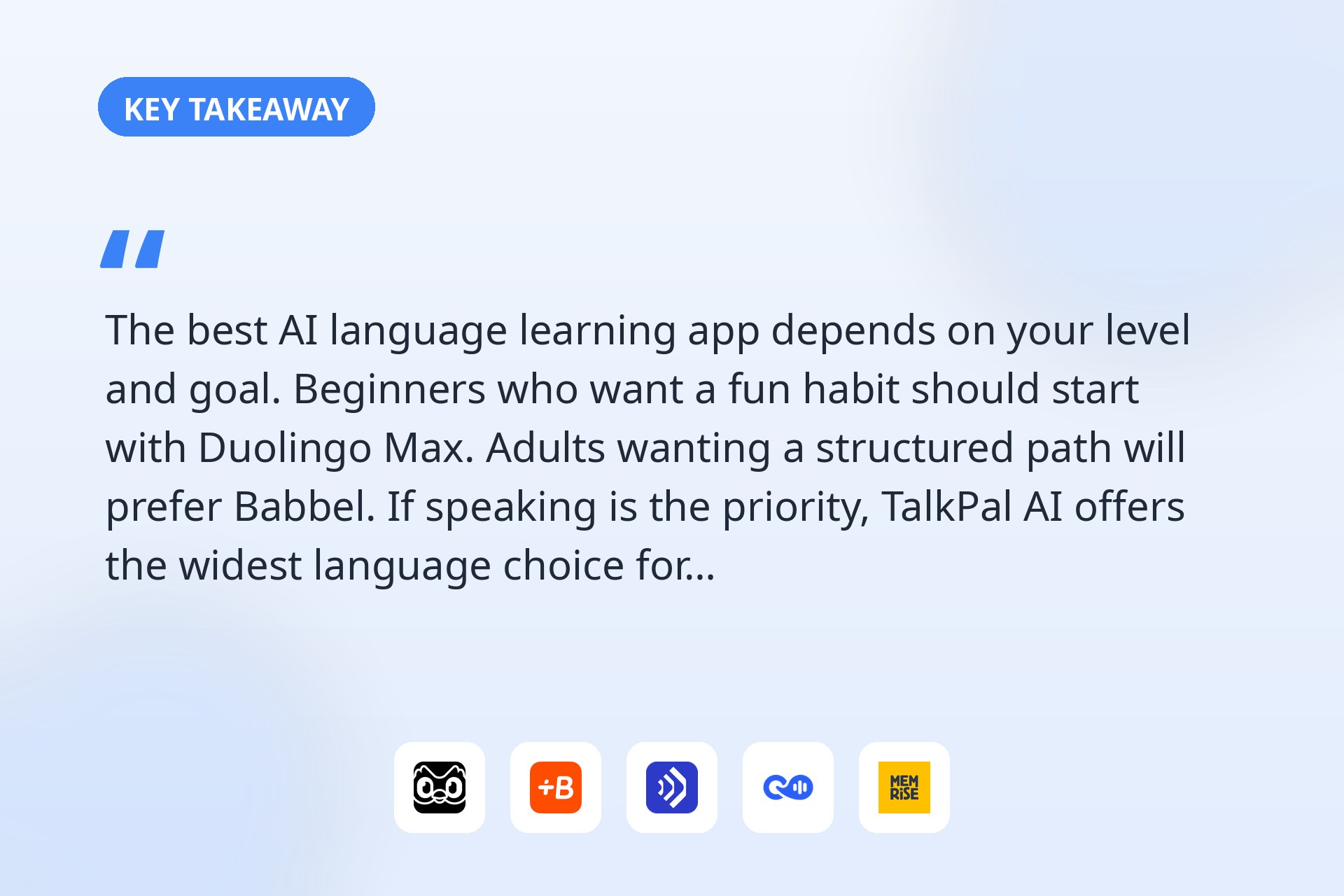
The best AI language learning app depends on your level and goal. Beginners who want a fun habit should start with Duolingo Max. Adults wanting a structured path will prefer Babbel. If speaking is the priority, TalkPal AI offers the widest language choice for conversation practice, while Loora is the pick for English specifically, and Memrise bridges the gap to real-world listening. Try the free tiers first, then check current pricing on the official sites before subscribing.
Reader reviews
Loading reviews…